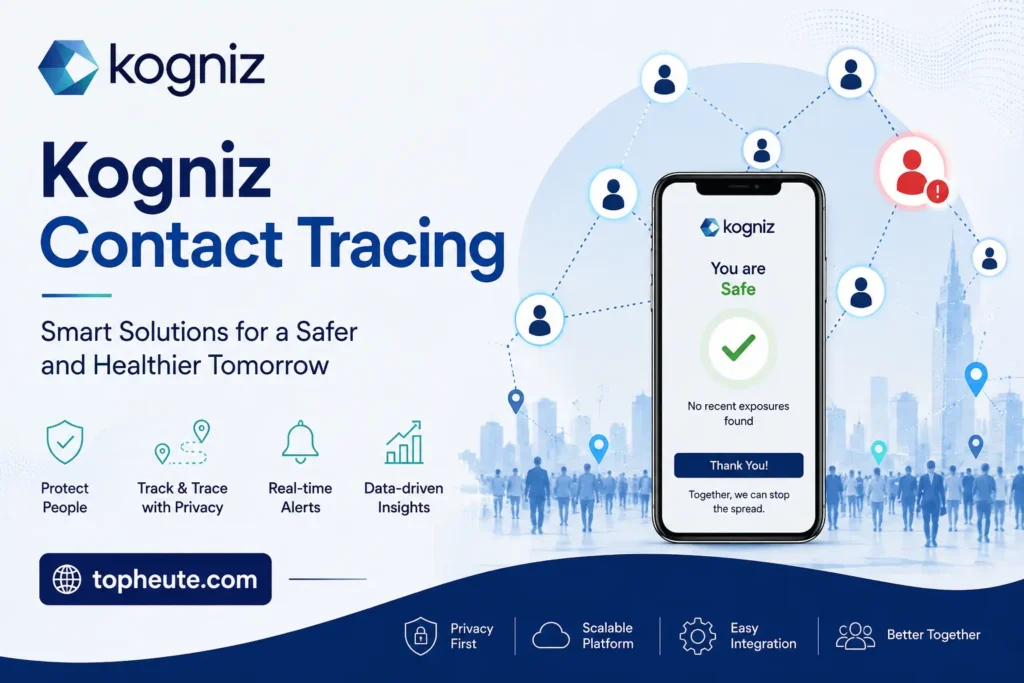
Kogniz contact tracing refers to a workplace-oriented technology solution built around contact-tracing wearables and a gateway. The system was designed to help organizations identify close interactions, support social-distancing practices, and produce contact-tracing information more quickly than a fully manual process. Current product material describes the gateway and wearables as working with the broader Kogniz AssureAI platform and other technologies an organization may already use.
For someone encountering the term for the first time, the basic idea is simple: participating people carry or wear a device, the system records relevant proximity interactions, and authorized personnel can use the resulting information when an exposure or safety event needs to be investigated. It is better understood as an operational safety tool than as a replacement for public-health judgment or medical diagnosis.
Why does this matter in 2026? The original pandemic-driven demand for digital contact tracing has changed, but the underlying need to understand interactions, improve workplace safety, and respond quickly to incidents remains relevant. Organizations considering this type of technology should therefore evaluate the actual workflow, data practices, deployment requirements, and current product availability rather than assuming that a COVID-era use case automatically applies today.
Kogniz Contact Tracing
The solution is centered on two physical components: employee wearables and a gateway. Kogniz describes these components as supporting contact tracing and social distancing, with immediate feedback for employees, remote notifications for non-compliance, and contact-tracing reports. The broader platform can also connect safety information with other workplace technologies.
What problem is the system trying to solve? In a conventional environment, an organization may have to reconstruct who interacted with whom by interviewing employees, checking schedules, reviewing access information, or examining other records. A proximity-based system can provide an additional technical record of interactions, making the investigation process more structured and potentially faster.
It is important not to confuse proximity detection with proof of infection. A contact event indicates that devices met defined conditions for proximity or interaction; it does not establish that transmission occurred. Health decisions still depend on the relevant public-health rules, clinical information, organizational policy, and the circumstances of the event.
How Kogniz Contact Tracing Works
At a high level, the workflow has four stages: equip participants, detect relevant proximity events, collect and process the interaction information, and provide reports or alerts to authorized users. The gateway acts as the infrastructure that receives or manages information from the deployed devices.
How does the process work in practice? An organization first identifies the people, areas, or shifts that need coverage and defines its safety rules. Participating personnel use the supplied wearable devices. When devices come within the configured proximity conditions, the system can record the interaction. If a social-distancing rule is being violated, the wearable can provide immediate feedback, while designated personnel can receive remote notifications.
The resulting records can then support an exposure investigation. Instead of asking every employee to remember every close interaction, an authorized safety team can use the available contact information as one evidence source. The exact thresholds, retention rules, alert behavior, and investigation procedure should be established by the deploying organization rather than assumed from generic descriptions of the technology.
Kogniz Contact Tracing Gateway
The gateway is the infrastructure component that connects the wearable-based contact-tracing setup with the organization’s operational environment. Current product descriptions specifically identify a contact-tracing gateway alongside the wearables and describe the combined solution as supporting contact tracing and social distancing.
Why is a gateway needed? Wearables need a way to participate in a managed system rather than functioning as isolated devices. The gateway provides the bridge through which interaction information can be collected and used by the organization’s contact-tracing workflow.
A useful deployment question is where the gateways need to be placed and how coverage will be maintained across the facility. Large buildings, multiple floors, production areas, entrances, outdoor spaces, and restricted zones may have different connectivity and operational requirements. Those details should be confirmed with the vendor during implementation because public product summaries do not provide enough information to guarantee a particular site layout.
Kogniz Contact Tracing Wearables
Wearables are the employee-facing part of the solution. Kogniz product material describes them as employee wearables designed for contact tracing and social distancing, with immediate feedback when distancing requirements are not followed. The same material highlights long-range and long-battery characteristics.
Why use a wearable instead of relying only on manual reporting? People are not always able to remember every interaction, particularly in busy workplaces where teams move between rooms, shifts, production lines, meeting areas, and shared facilities. A purpose-built device can provide a more consistent technical record of proximity events.
However, a wearable program works only when people actually use the devices correctly. Organizations need a clear process for issuing, charging, wearing, replacing, cleaning where appropriate, and returning equipment. They also need straightforward employee communication so workers understand what the technology records, why it is being used, and who is allowed to access the resulting information.
Kogniz Contact Tracing Features
The core value of the system comes from combining proximity monitoring with operational alerts and reporting. Current Kogniz and channel material identifies employee wearables, a gateway, social-distancing support, immediate employee feedback, remote notifications, instant contact-tracing reports, and long-range, long-battery operation.
Key capabilities include:
Wearable-based proximity detection for participating personnel.
Immediate feedback when defined social-distancing rules are not followed.
Remote notifications for designated personnel.
Contact-tracing reports that can support exposure investigations.
Gateway infrastructure for managing the deployed wearable environment.
Integration with the broader AssureAI ecosystem and other workplace technologies.
These features should be treated as components of a workflow rather than isolated functions. The strongest implementation is one in which detection leads to an understandable alert, the alert leads to an appropriate investigation, and the investigation leads to a documented organizational response.
Real-Time Contact Tracing
Real-time capability is valuable because safety teams often need information while an event is still actionable. Immediate feedback can help an employee correct a distancing issue at the moment it happens, while remote notifications can give designated personnel visibility without requiring them to stand beside the employee.
Does real-time mean that every interaction instantly becomes a confirmed exposure? No. Real-time monitoring refers to the speed at which the system can detect, communicate, or report relevant events. Whether an event represents a meaningful exposure requires context and, where appropriate, public-health or medical guidance.
The practical benefit is reduced delay. Faster awareness can help an organization investigate an event sooner, identify potentially relevant contacts, review workplace conditions, and apply its established response process.
Social Distancing Monitoring
Social-distancing monitoring is one of the clearest use cases associated with the technology. The wearables can provide immediate feedback when a defined distance rule is not followed, while Kogniz also describes camera-based distance monitoring elsewhere in its broader product ecosystem.
How should an organization use this capability responsibly? Distance rules should be based on the organization’s current safety requirements rather than treated as a universal number that applies in every situation. Work type, local guidance, physical barriers, ventilation, duration of interaction, and the nature of the environment can all affect the meaning of a proximity event.
The goal is not to watch employees for its own sake. The goal is to create an actionable safety signal that helps people maintain agreed workplace practices and gives safety teams better information when intervention is needed.
Contact Tracing Reports and Alerts
Reports turn raw interaction events into information that people can use. Kogniz product descriptions specifically mention instant contact-tracing reports and remote notifications. A useful reporting workflow should help an authorized team understand the relevant event, the people or devices involved, the time period, and the next action required.
Alerts are different from reports. An alert is designed to prompt timely attention, while a report supports investigation, documentation, and review. Keeping those purposes separate helps prevent alert overload and makes it easier for safety teams to prioritize genuinely important events.
What makes an alert useful? It should be understandable, routed to the right person, tied to a defined action, and governed by a clear escalation process. Otherwise, even technically fast notifications can become noise.
Kogniz Contact Tracing for Workplace Safety
Workplace safety is the broader context in which this technology makes the most sense. Kogniz is described as a workplace-safety provider using AI across visual, text, and sensor-based data, with capabilities extending beyond pandemic controls. Those broader capabilities include occupational safety, evacuations, personnel accountability, physical security, and other safety scenarios.
For a safety manager, the advantage of a broader ecosystem is operational continuity. The organization may already have cameras, sensors, reporting processes, and safety policies. A contact-tracing capability can be considered as one part of that environment instead of creating a completely separate safety program.
Still, contact tracing should not replace normal workplace controls. Ventilation, hygiene, training, sick-leave policies, occupational-health procedures, emergency planning, and clear communication remain important. Technology can improve information flow; it cannot compensate for a weak safety program.
Kogniz Contact Tracing for Businesses and Organizations
The solution can be relevant to organizations where employees, contractors, visitors, or students interact frequently and where management needs a structured way to investigate proximity events. Current listings associate Kogniz with manufacturers, retail organizations, private employers, universities, higher-education institutions, entertainment and hospitality organizations, and government agencies.
Who benefits most? A useful candidate is an organization with a large or mobile workforce, multiple work areas, repeated close interactions, or a strong need for documented safety operations. Smaller environments may have less operational complexity and may be able to manage some contact investigations manually.
Before deployment, decision-makers should define the problem first. They should ask what information is currently missing, how an exposure investigation is performed, which people need access, how long records should be retained, and what response will follow an alert. Those questions prevent an organization from buying technology without a clear operational purpose.
Kogniz Contact Tracing and COVID-19 Management
Contact tracing became especially important during COVID-19 because organizations needed faster ways to identify potentially relevant interactions and manage workplace exposure concerns. Kogniz is still described in current software listings as supporting COVID-19 control through contact tracing, vaccine or test management, and related safety functions.
That historical context matters, but it should not be confused with today’s public-health situation. A 2026 article should not imply that emergency pandemic rules or specific distancing requirements automatically remain in force. Current organizational policies should be based on applicable guidance and the actual health and safety risk being managed.
The lasting lesson from the COVID-19 period is operational: organizations benefit when safety information can be collected consistently, investigated quickly, and communicated clearly.
Explore more amazing, latest, and insightful articles Visit topheute.com.
Kogniz Contact Tracing and Vaccine Management
Vaccine and test management sits alongside contact tracing in descriptions of Kogniz’s pandemic-spread-control capabilities. These functions address different questions. Contact tracing focuses on relevant interactions, while vaccination and testing workflows concern health-status information and organizational eligibility or response processes.
Why keep these functions conceptually separate? Health-status information is especially sensitive. Combining it with interaction records can create additional privacy and access risks. An organization should therefore define which information is necessary, who can access it, how long it is retained, and whether every piece of information truly needs to be connected.
A mature safety workflow uses the minimum information required for the defined purpose. It also separates operational reporting from unnecessary disclosure of personal health information.
Kogniz AssureAI and Kogniz Contact Tracing
Kogniz AssureAI is the broader platform context around several Kogniz workplace-safety capabilities. Current descriptions say the platform can apply AI to visual, text, and sensor-based data and support areas such as occupational safety, evacuations, security, and pandemic-spread controls.
How does contact tracing fit into that ecosystem? The contact-tracing gateway and wearables provide a proximity-oriented data source, while other AssureAI components can address different safety signals. For example, Kogniz materials describe IP-camera integration, occupancy monitoring, PPE enforcement, person counting, and a distance camera with real-time visual alerts.
The important distinction is that these are complementary capabilities, not necessarily one single device doing everything. An organization should map each safety requirement to the appropriate component and verify current integrations, hardware compatibility, and deployment architecture before procurement.
Kogniz Contact Tracing Privacy and Data Security
Privacy is one of the most important questions in any technology that records interactions between people. The organization should explain what is collected, why it is collected, how it is protected, who can see it, and when it is deleted.
Is contact information the same as medical information? Not necessarily. A proximity record can show that two devices were near each other, but linking that event to a person’s health status creates a much more sensitive dataset. Access controls should therefore distinguish between ordinary operational records and health-related information.
A responsible deployment should establish data minimization, role-based access, retention limits, security controls, incident-response procedures, employee notice, and applicable legal or regulatory requirements. Public product descriptions alone are not enough to establish an organization’s compliance; those requirements must be assessed for the actual deployment.
Benefits of Kogniz Contact Tracing
The main benefit is faster access to structured interaction information. That can reduce reliance on memory and manual reconstruction when a safety event requires investigation.
Other potential benefits include:
Faster identification of potentially relevant contacts.
Immediate feedback for social-distancing behavior.
Remote notification for designated safety personnel.
More consistent contact-tracing records.
Better visibility during workplace investigations.
Integration with a wider workplace-safety technology environment.
Reduced administrative effort for repeated manual interaction tracking.
The value depends on implementation quality. A technically capable system will not improve safety if devices are not worn, alerts are ignored, access is poorly governed, or the organization has no defined response procedure.
Kogniz Contact Tracing vs. Traditional Contact Tracing
Traditional contact tracing commonly depends on interviews, personal recollection, schedules, attendance records, and other manually assembled information. It can be useful because people can provide context that a device cannot, but it can also be time-consuming and affected by incomplete memories.
A technology-assisted approach adds a machine-generated proximity record. That can make the investigation faster and more systematic, especially in large workplaces. The strongest approach is often complementary: technical records can identify potentially relevant interactions, while trained personnel provide context and decide what the information means.
What is the biggest difference? Traditional tracing asks people to reconstruct interactions; digital tracing can provide an additional data trail from the technology itself. Neither approach should be treated as infallible.
Kogniz Contact Tracing in 2026
In 2026, the most sensible way to evaluate this technology is through current operational needs rather than the pandemic alone. Kogniz remains described by current software directories and channel material as a broader AI-enabled workplace-safety platform with contact tracing among its capabilities, while its product material continues to identify contact-tracing wearables and a gateway.
Organizations should ask whether they need proximity monitoring today, what safety problem it will solve, and whether the current product version supports their required environment. They should also verify hardware availability, integration options, data governance, support arrangements, deployment costs, and current regulatory requirements before making a procurement decision.
The technology landscape has also moved toward multimodal safety systems. Computer vision, sensors, wearables, occupancy information, alerts, and analytics can work together to provide a more complete operational picture. The strategic opportunity is therefore not simply to automate an old contact-tracing task, but to use reliable safety data as part of a broader risk-management workflow.
FAQs
What is Kogniz contact tracing?
It is a technology-assisted contact-tracing solution centered on employee wearables and a gateway. It is designed to support proximity monitoring, social-distancing feedback, notifications, and contact-tracing reports.
How does Kogniz contact tracing work?
Participating personnel use wearable devices that can detect relevant proximity events. The gateway supports the managed collection and use of that information, while alerts and reports can help authorized personnel respond to safety events.
What is the Kogniz Contact Tracing Gateway?
It is the gateway component used with the contact-tracing wearables. Kogniz describes the gateway and wearables as a combined solution for contact tracing and social distancing.
What are Kogniz contact tracing wearables?
They are employee-facing devices designed to support proximity monitoring and social-distancing feedback. Product material also describes them as having long-range and long-battery characteristics.
Does the system prove that someone was infected?
No. A proximity event does not prove infection or transmission. It is an operational data point that may support an exposure investigation.
Can it provide real-time alerts?
Yes. Kogniz product material describes immediate employee feedback for social-distancing violations and remote personnel notifications.
Who can use this type of technology?
Potential users include organizations with large or mobile workforces, manufacturers, businesses, universities, hospitality and entertainment organizations, and government agencies. Suitability depends on the organization’s actual safety requirements.
How does AssureAI relate to contact tracing?
AssureAI is the broader Kogniz workplace-safety platform. Contact-tracing wearables and the gateway can be considered alongside other safety technologies in that ecosystem.
Is contact tracing still relevant in 2026?
It can be, but the use case should be based on current organizational needs and applicable health and safety requirements rather than assuming pandemic-era rules still apply.
What should an organization check before deployment?
It should evaluate the required coverage, wearable management, gateway placement, alert workflow, reporting needs, data access, retention, security, employee communication, integrations, support, and current compliance obligations.
Conclusion
Kogniz contact tracing is best understood as a technology-assisted workplace safety capability rather than a standalone substitute for human investigation or public-health decision-making. Its core model combines employee wearables and a gateway to support proximity monitoring, social-distancing feedback, notifications, and contact-tracing reports.
For organizations evaluating the technology in 2026, the most important question is not simply whether contact tracing can be automated. It is whether the technology solves a real operational problem, fits the organization’s existing safety environment, protects sensitive information, and produces information that people can act on. When those conditions are met, digital proximity data can become a useful part of a broader, well-governed safety program.
Explore more amazing, latest, and insightful articles Visit topheute.com.