
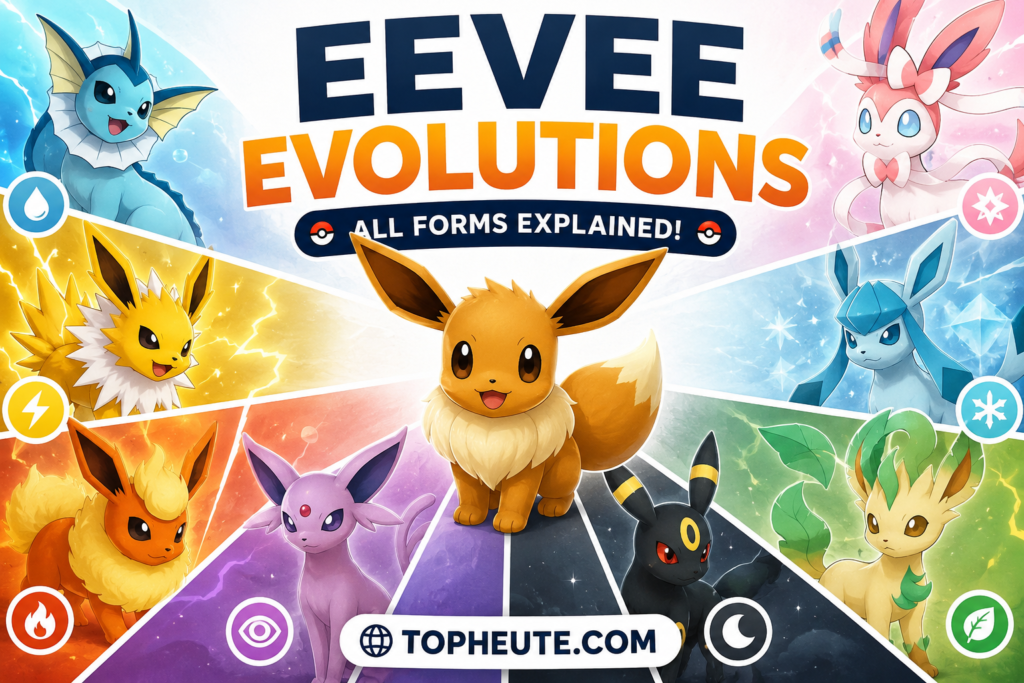
Eevee is one of the most unusual Pokémon because its unstable genetic makeup allows it to develop into several different forms. The eight officially recognized forms are Vaporeon, Jolteon, Flareon, Espeon, Umbreon, Leafeon, Glaceon, and Sylveon. The important part for a new player is that there is no single universal method that works in every Pokémon game. The required item, friendship condition, location, move, or Pokémon GO mechanic depends on the game you are playing.
This guide brings the whole subject together in one place. It explains what each form is, how the evolution works, which requirements matter, how the methods differ between games, how Pokémon GO handles the process, and how to choose a form when you have more than one option. The goal is simple: you should be able to find the answer you need without having to piece together mechanics from several different guides.
For the core species information, the official Pokédex lists Eevee as Pokémon #0133 and identifies the eight forms as #0134 Vaporeon, #0135 Jolteon, #0136 Flareon, #0196 Espeon, #0197 Umbreon, #0470 Leafeon, #0471 Glaceon, and #0700 Sylveon. Pokémon also describes Eevee‘s genetic code as irregular, which is the in-universe reason it can take so many different evolutionary paths. Source checked: Pokémon.com official Pokédex, current 2026 crawl.
Eevee Evolutions: All 8 Eeveelutions
There are eight official forms currently associated with Eevee. They cover eight different types: Water, Electric, Fire, Psychic, Dark, Grass, Ice, and Fairy. The first three arrived in the original Kanto era, two more were introduced in Johto, two in Sinnoh, and the final one in Kalos.
| Pokémon | Type | Generation | Common evolution route |
| Vaporeon | Water | Generation I | Water Stone in many main-series games |
| Jolteon | Electric | Generation I | Thunder Stone in many main-series games |
| Flareon | Fire | Generation I | Fire Stone in many main-series games |
| Espeon | Psychic | Generation II | High friendship plus daytime in games using the day/night friendship method |
| Umbreon | Dark | Generation II | High friendship plus nighttime in games using the day/night friendship method |
| Leafeon | Grass | Generation IV | Moss Rock or Leaf Stone depending on the game |
| Glaceon | Ice | Generation IV | Ice Rock or Ice Stone depending on the game |
| Sylveon | Fairy | Generation VI | High friendship plus a Fairy-type move in games using that requirement |
The exact method should always be matched to the specific game. That distinction matters because a method that is correct for one title may be unavailable or replaced in another. The official Pokémon site has also documented the classic methods: Water Stone for Vaporeon, Thunder Stone for Jolteon, Fire Stone for Flareon, friendship with daytime for Espeon, friendship with nighttime for Umbreon, Moss Rock for Leafeon, Ice Rock for Glaceon, and high friendship plus a Fairy-type move for Sylveon in the relevant games.
Eevee Evolutions Chart
| Evolution | Type | Era introduced | Key idea |
| Vaporeon | Water | Kanto | Water Stone |
| Jolteon | Electric | Kanto | Thunder Stone |
| Flareon | Fire | Kanto | Fire Stone |
| Espeon | Psychic | Johto | Friendship + daytime |
| Umbreon | Dark | Johto | Friendship + nighttime |
| Leafeon | Grass | Sinnoh | Moss Rock or Leaf Stone |
| Glaceon | Ice | Sinnoh | Ice Rock or Ice Stone |
| Sylveon | Fairy | Kalos | Friendship + Fairy-type move |
A useful way to remember the chart is to divide the family into three groups. The original Kanto trio uses elemental stones. The Johto pair depends on friendship and the time of day in games with that mechanic. The Sinnoh pair originally introduced location-based evolution, although later games can use stones instead. Sylveon uses a friendship-based Fairy requirement in the games that retain that system.
Vaporeon
Vaporeon is the Water-type form. It is one of the three original forms and is traditionally obtained by using a Water Stone on Eevee. Its design and abilities are strongly associated with water, and it is the natural choice when you want a Water-type addition without using a different species.
In battle, Vaporeon is generally associated with strong HP and useful Water-type options rather than extreme speed. Its exact stats, moves, abilities, and competitive value can change by game, so do not assume that a moveset or ranking from one title automatically applies to another.
For a beginner, the key point is simple: if the game uses the traditional stone method, obtain a Water Stone, select it from your bag, and use it on Eevee. No friendship or time-of-day condition is needed for that classic route.
Jolteon
Jolteon is the Electric-type form and another member of the original trio. In games that use the classic method, a Thunder Stone triggers the change.
Jolteon is particularly known for speed and Special Attack. The official Pokémon strategy material has described it as the fastest of Eevee’s forms, while also noting that its defensive profile is less impressive. That combination makes it attractive when you value quick offensive pressure.
The main thing to remember is the Ground-type matchup. Ground-type Pokémon are immune to Electric-type attacks, so an Electric-focused strategy needs coverage or a teammate that can handle that weakness.
Flareon
Flareon is the Fire-type form and completes the original Kanto trio. A Fire Stone is the traditional evolution item.
Flareon is notable for its Attack and Special Defense. Official Pokémon strategy material highlights its high Attack but also points out that low HP and Speed can make it harder to use aggressively. Its strongest physical Fire attacks can hit hard, but the best set depends on the generation and battle format.
Choose Flareon when you specifically need a Fire type, like its design and role, or want to build a team around its physical strengths. Do not choose it solely because a ranking puts it high or low; the best choice changes with the game and your team.
Espeon
Espeon is the Psychic-type form introduced in Generation II. Unlike the original stone-based trio, it uses a friendship-based evolution method in games that retain the classic system.
The usual requirement is high friendship followed by a level-up during the day. The exact implementation can vary by title, so check the game’s own friendship mechanics before evolving. In games where the method applies, the combination of friendship and daytime is what separates Espeon from Umbreon.
Espeon is known for strong Special Attack and Speed. It can work as a fast special attacker or, depending on the game, a support-oriented Pokémon. The official Pokémon strategy guide has also highlighted Espeon’s ability to use defensive support and its strong Special Attack.
If you want Espeon, build friendship first, make sure Eevee is eligible for the friendship evolution, and then level it during the correct daytime period. If the game has another evolution system, follow that title’s rules instead.
Umbreon
Umbreon is the Dark-type form from Generation II. In games using the traditional friendship system, it is the nighttime counterpart to Espeon.
The standard route is high friendship followed by a level-up at night. If you level Eevee at the wrong time, you can get a different result, so the time-of-day requirement should be checked before pressing the evolution button.
Umbreon is the defensive specialist of the family in many traditional battle contexts. Official Pokémon strategy material describes its high defensive and HP profile and its comparatively low offensive power. It can be valuable when your team needs durability, disruption, or a Pokémon that can absorb pressure rather than simply deal damage quickly.
A common beginner mistake is to think that Dark type automatically means an aggressive attacker. Umbreon’s role is often the opposite: it can win value by staying alive, disrupting the opponent, and supporting the rest of the team.
Leafeon
Leafeon is the Grass-type form introduced in Generation IV. Its evolution method is one of the clearest examples of why game-specific instructions matter.
In older titles that use the original Sinnoh-style mechanic, Eevee evolves when leveled near a Moss Rock. Later games can replace the location requirement with a Leaf Stone. The official Pokémon information has documented the Moss Rock method, while newer titles may provide the stone route instead.
Leafeon is a physical-leaning Grass-type option in many games. Its strengths can include physical Attack and Defense, although the exact stats and available moves vary by title.
Before evolving, check whether your game expects a Moss Rock or a Leaf Stone. If you are following a guide written for another generation, do not assume its location instructions still apply.
Glaceon
Glaceon is the Ice-type form introduced alongside Leafeon in Generation IV. Its classic method uses an Ice Rock location, while later games can use an Ice Stone.
Glaceon is associated with strong special attacking potential and Ice-type coverage. Its main drawback is that Ice has several defensive weaknesses, so the value of the form depends heavily on the team and game.
For the evolution itself, the important question is not simply ‘how do I get an Ice Stone?’ but ‘which evolution mechanic does my game use?’ Older location-based systems and newer item-based systems are both part of the franchise history.
Sylveon
Sylveon is the Fairy-type form and the newest of the eight established forms. It was introduced in Generation VI and added a Fairy-type path to the family.
In games using the classic Sylveon requirement, Eevee needs high friendship and must know at least one Fairy-type move. The official Pokémon site has described this combination directly.
This creates an important difference from Espeon and Umbreon. Friendship alone is not enough when the Fairy-move condition is part of the game’s rules. If the game has replaced or modified the affection system, use its current equivalent rather than copying instructions from an older title.
Sylveon is often valued for Fairy typing, useful special attacking potential, and strong matchups into Dragon-type opponents. Its exact competitive role depends on the generation, available moves, abilities, and format.
How to Evolve Eevee Into Every Eevee Evolution
The safest approach is to identify your game first. Once you know the title, identify which evolution system it uses. This prevents the most common problem with online guides: combining instructions from different generations.
For Vaporeon, use a Water Stone when the game uses the traditional stone method.
For Jolteon, use a Thunder Stone when the game uses the traditional stone method.
For Flareon, use a Fire Stone when the game uses the traditional stone method.
For Espeon, raise friendship and level up during the daytime in games using that method.
For Umbreon, raise friendship and level up during nighttime in games using that method.
For Leafeon, use the Moss Rock method in games that retain it, or a Leaf Stone where the game provides that replacement.
For Glaceon, use the Ice Rock method in games that retain it, or an Ice Stone where supported.
For Sylveon, meet the friendship requirement and the Fairy-type move requirement in games that use those conditions.
If you want to control the result, do not level Eevee until you have confirmed the requirements. This is especially important for friendship-based forms, because a single level-up at the wrong time can lead to an unintended evolution in games where multiple conditions are possible.
Eevee Evolution Methods
There are four broad mechanics behind the family: evolutionary stones, friendship plus time of day, location-based evolution, and friendship plus a move requirement. Pokémon GO is a separate system and should not be confused with the main-series rules.
| Method | Forms commonly associated with it | What to watch for |
| Water/Thunder/Fire Stone | Vaporeon, Jolteon, Flareon | Use the correct elemental stone |
| Friendship + daytime | Espeon | Day/night rules depend on the title |
| Friendship + nighttime | Umbreon | Nighttime rules depend on the title |
| Moss Rock / Leaf Stone | Leafeon | Location method changed in some newer titles |
| Ice Rock / Ice Stone | Glaceon | Location method changed in some newer titles |
| Friendship + Fairy-type move | Sylveon | The move and friendship conditions must both be satisfied where applicable |
One of the most important practical rules is to avoid treating the franchise as if every game shares one evolution engine. The same Pokémon can have a different evolution method in a newer title. That is why a correct guide needs to explain both the classic method and the modern variation.
Eevee Evolutions in Pokémon GO
Pokémon GO handles the process differently from the main-series games. You use Eevee Candy and Pokémon GO-specific conditions rather than the traditional main-series evolution items and battle mechanics.
The three original forms—Vaporeon, Jolteon, and Flareon—can be selected through the evolution screen when the random evolution is available, while the other forms have additional methods. The nickname method is especially useful because it lets a player target a particular result rather than relying on chance, but the special nickname trick is limited.
For Espeon and Umbreon, Pokémon GO uses a Buddy-based route. The general method involves making Eevee your buddy, walking the required distance, and then evolving it at the appropriate time of day while it remains your buddy. The evolution button is the safest place to verify which result the game currently expects before spending Candy.
For Leafeon and Glaceon, Pokémon GO uses special Lure Modules at PokéStops. For Sylveon, the route uses Buddy interaction and hearts. These are Pokémon GO mechanics, not instructions for the main-series games.
Event rules can temporarily change or add bonuses. For example, official Pokémon GO event information has used temporary distance and heart requirements for Eevee evolutions, which shows why event-specific instructions should not be treated as permanent rules.
Explore more amazing, latest, and insightful articles Visit topheute.com.
Eevee Evolution Nickname Trick
The nickname trick is one of the most searched Pokémon GO methods because it can force a particular result without leaving the outcome entirely to chance. The classic names are Rainer for Vaporeon, Sparky for Jolteon, Pyro for Flareon, Sakura for Espeon, Tamao for Umbreon, Linnea for Leafeon, Rea for Glaceon, and Kira for Sylveon.
| Target | Nickname |
| Vaporeon | Rainer |
| Jolteon | Sparky |
| Flareon | Pyro |
| Espeon | Sakura |
| Umbreon | Tamao |
| Leafeon | Linnea |
| Glaceon | Rea |
| Sylveon | Kira |
The critical warning is that the nickname method is not an unlimited shortcut. It is intended as a one-time targeting trick for each form on an account. Before you spend your Candy, change the name, confirm that the evolution preview shows the desired silhouette, and only then evolve. If the expected silhouette does not appear, stop and check the requirement rather than taking the chance.
This is also why you should not confuse the nickname trick with the ordinary evolution method. The nickname is a targeting shortcut; it does not replace the underlying Pokémon GO system for repeated evolutions.
Eevee Evolution Requirements
The requirements depend on the game, but the decision process is easy: first identify the title, then identify the form, then confirm the requirement shown by that game.
| Situation | Main thing to verify |
| Main-series stone evolution | Correct evolutionary stone |
| Espeon route | Friendship and daytime condition |
| Umbreon route | Friendship and nighttime condition |
| Leafeon route | Moss Rock or Leaf Stone, depending on game |
| Glaceon route | Ice Rock or Ice Stone, depending on game |
| Sylveon route | Friendship and Fairy-type move where required |
| Pokémon GO | Candy plus the specific GO evolution requirement |
If an evolution is not appearing as expected, check the obvious blockers first: wrong game, wrong time of day, insufficient friendship, missing Fairy-type move, wrong location, wrong stone, or an event-specific rule. Most failed evolutions are caused by one of these conditions.
How to Get Every Eevee Evolution in Pokémon GO
To collect the full family in Pokémon GO, plan the process rather than evolving every Eevee immediately. Save the nickname trick for a form you specifically want, and use the repeatable methods for later copies.
Keep enough Eevee Candy before starting a collection project.
Use the evolution preview to confirm the intended result before confirming the evolution.
Use the nickname trick carefully because its guaranteed targeting is limited.
Use the Buddy route for Espeon and Umbreon when the current in-game requirement calls for it.
Use the appropriate Lure Module for Leafeon or Glaceon.
Use the Buddy-heart route for Sylveon when the current game requirement is active.
For Vaporeon, Jolteon, and Flareon, be aware that ordinary evolution can produce different results rather than letting you choose freely.
Check event announcements before evolving during a special event because temporary moves or requirements can change the best timing.
A useful collection strategy is to keep a small reserve of high-quality Eevee instead of using every one as soon as you catch it. This gives you flexibility for future events, better IV choices, or a particular battle role.
Best Eevee Evolution
There is no single best choice for every player or every game. ‘Best’ depends on what you want the Pokémon to do. A player who needs a durable Dark-type has a different answer from someone who needs a Fairy attacker, a fast Electric attacker, or a Water-type team member.
| If your priority is… | A strong candidate to consider | Why |
| Durability and defensive play | Umbreon | Known for a sturdy defensive profile |
| Fast special offense | Jolteon or Espeon | Both are associated with speed and special attacking strength in many games |
| Fairy typing | Sylveon | Provides Fairy-type coverage and a distinctive role |
| Water typing | Vaporeon | Straightforward Water-type option |
| Fire typing | Flareon | Strong physical Attack in many main-series contexts |
| Grass typing | Leafeon | Physical Grass-oriented role |
| Ice typing | Glaceon | Strong special Ice-oriented role |
For a new player, the best choice is usually the one that fills a real team need. If you already have three Water Pokémon, another Water-type may add less value than a Fairy, Dark, Electric, or Fire option. Team balance is more useful than a universal ranking.
Strongest Eevee Evolution
Strength is format-dependent. A Pokémon that performs well in a main-series story team may not be the strongest choice in competitive battles, and a Pokémon that performs well in Pokémon GO raids can have a very different ranking in GO Battle League.
In traditional main-series play, Espeon can provide high Special Attack and Speed, Umbreon is notable for durability, Jolteon for speed and special offense, Flareon for Attack, and Sylveon for Fairy-type utility. These are broad role descriptions rather than a promise that one form will always win.
The official Pokémon strategy material similarly treats the forms as specialists rather than declaring one universal winner. Jolteon is described as exceptionally fast, Flareon as physically powerful but limited by low Speed and HP, Espeon as a strong special attacker/support option, and Umbreon as the sturdiest member of the group.
Eevee Evolutions Ranked
A ranking is only meaningful when the criteria are stated. For a general-purpose main-series perspective, a practical ranking can be built around role flexibility, useful typing, survivability, offensive potential, and how easily the form fits into a normal team. It should not be presented as an absolute competitive ranking across every game.
| Rank | Form | General reason |
| 1 | Sylveon | Excellent Fairy typing and a useful mix of offense and special utility |
| 2 | Umbreon | Exceptional defensive identity and strong staying power |
| 3 | Espeon | High Speed and Special Attack create immediate offensive pressure |
| 4 | Jolteon | Very fast Electric attacker with useful offensive potential |
| 5 | Vaporeon | Reliable Water typing and strong HP-oriented profile |
| 6 | Leafeon | Good physical profile and useful Grass typing |
| 7 | Glaceon | Strong Ice offense but a difficult defensive typing |
| 8 | Flareon | High Attack but Speed and HP limitations can restrict its role |
This is a general educational ranking, not an official Pokémon ranking. Community opinions vary substantially, which is normal for a family with eight specialized forms. The Pokémon community has recent discussions ranking the forms in very different orders, reinforcing the point that ‘best’ depends on the player’s criteria.
Eevee Evolutions by Type
The family is valuable partly because each form represents a different elemental identity. The type tells you what kind of attacks the Pokémon specializes in and what matchups it can create.
Vaporeon — Water: useful against Fire, Ground, and Rock targets.
Jolteon — Electric: strong against Water and Flying targets, while Ground types are a major defensive concern.
Flareon — Fire: useful against Grass, Ice, Bug, and Steel targets.
Espeon — Psychic: useful against Fighting and Poison targets.
Umbreon — Dark: useful against Psychic and Ghost targets.
Leafeon — Grass: useful against Water, Ground, and Rock targets.
Glaceon — Ice: useful for Ice-type offensive coverage, especially against several Dragon, Flying, Ground, and Grass matchups.
Sylveon — Fairy: especially valuable for Fairy-type coverage and Dragon-related matchups.
Remember that type advantages are only one part of battle performance. Abilities, moves, stats, held items, team composition, and the specific game’s mechanics can change the practical result.
Eevee Evolutions by Generation
| Generation | Forms introduced | Forms |
| Generation I | 3 | Vaporeon, Jolteon, Flareon |
| Generation II | 2 | Espeon, Umbreon |
| Generation III | 0 | No new form |
| Generation IV | 2 | Leafeon, Glaceon |
| Generation V | 0 | No new form |
| Generation VI | 1 | Sylveon |
| Generation VII | 0 | No new form |
| Generation VIII | 0 | No new form |
| Generation IX | 0 | No new form |
The timeline explains why the family has eight forms rather than one form for every Pokémon type. New forms were introduced in specific generations, and there are currently no official forms covering types such as Dragon, Ghost, Steel, or Poison. Fan-made concepts for additional forms are not official species data and should not be confused with the established family.
Eevee Evolutions in Different Pokémon Games
Game-specific differences are one of the biggest sources of confusion. The safest rule is: never apply a Pokémon GO method to a main-series game, and never assume a method from an older main-series title still works exactly the same way in a newer title.
In classic games, the first three forms are associated with Water, Thunder, and Fire Stones. Espeon and Umbreon traditionally use friendship plus time of day. Leafeon and Glaceon were originally tied to special locations in the games that introduced them. Sylveon introduced a Fairy-type move condition alongside friendship.
Later titles can simplify or replace location-based mechanics with evolutionary stones. This is particularly important for Leafeon and Glaceon. If you are playing a newer title, use the mechanics actually available in that title instead of searching for a location that no longer performs the evolution.
Pokémon GO is a separate case. It uses Candy, Buddy interactions, Lure Modules, and its own nickname targeting method. It should be treated as its own evolution system rather than as a direct translation of the console games.
Eevee Evolutions for PvP and Raids
Battle value changes dramatically depending on the format. Main-series competitive battles, Pokémon GO Battle League, and Pokémon GO raids do not use the same stats, move pools, or battle calculations.
For Pokémon GO, do not select a form only because it is ranked highly on a generic list. Look at the specific league, allowed CP, moves, IV spread, and current meta. A Pokémon that looks impressive in raids may have a different value in PvP.
For main-series battles, consider role rather than popularity. Umbreon is naturally suited to defensive play, Espeon and Jolteon can provide speed and special pressure, Flareon can leverage physical Attack, and Sylveon can provide Fairy-type utility. The exact move set and ability can completely change how each one performs.
PvP: check the exact format and rules before choosing a form.
Raids: prioritize the form’s relevant attack type, moves, and current game balance.
Story play: choose based on team coverage and availability rather than tier lists.
Competitive play: evaluate stats, abilities, moves, items, and team synergy together.
Pokémon GO: evaluate current moves, CP, IVs, league limits, and the current meta.
FAQs
How many official Eevee forms are there?
There are eight officially recognized forms: Vaporeon, Jolteon, Flareon, Espeon, Umbreon, Leafeon, Glaceon, and Sylveon.
What is the easiest Eevee evolution to get?
In many main-series games, the elemental-stone forms are straightforward because you only need the correct stone. In Pokémon GO, the easiest route depends on which form you want and whether you have already used the nickname trick.
Can Eevee evolve into any type?
No. Eevee currently has eight official evolutionary forms, covering Water, Electric, Fire, Psychic, Dark, Grass, Ice, and Fairy.
Which form is the strongest?
There is no universal strongest form. The answer changes by game, battle format, moves, abilities, and the role your team needs.
Can I choose the result when using a stone?
Yes. The elemental stone determines the result in games that use the classic stone system: Water Stone gives Vaporeon, Thunder Stone gives Jolteon, and Fire Stone gives Flareon.
How do I get Espeon instead of Umbreon?
In games using the traditional friendship system, Espeon requires high friendship and a daytime level-up, while Umbreon uses nighttime. Always confirm the specific game’s implementation.
How do I get Umbreon instead of Espeon?
Raise the required friendship and level Eevee at night in games that use the classic method. In Pokémon GO, use the current Buddy-based requirements instead.
How do I evolve Eevee into Sylveon?
In games using the traditional Sylveon system, Eevee needs high friendship and at least one Fairy-type move. Pokémon GO uses its own Buddy-heart requirement.
Do Leafeon and Glaceon always need special rocks?
No. The original games used Moss Rock and Ice Rock locations, while later games can use Leaf Stone and Ice Stone methods.
Does the nickname trick work for every form in Pokémon GO?
The classic nicknames target all eight forms, but the guaranteed nickname shortcut is limited. After using a particular nickname shortcut, use the repeatable in-game requirements for future copies.
What are the Pokémon GO nickname names?
Rainer targets Vaporeon, Sparky targets Jolteon, Pyro targets Flareon, Sakura targets Espeon, Tamao targets Umbreon, Linnea targets Leafeon, Rea targets Glaceon, and Kira targets Sylveon.
Can I use main-series evolution instructions in Pokémon GO?
No. Pokémon GO has separate mechanics involving Candy, Buddy interactions, Lure Modules, and its own targeting methods.
Is Sylveon a Fairy type?
Yes. Sylveon is the Fairy-type form and was introduced in Generation VI.
Which forms were introduced first?
Vaporeon, Jolteon, and Flareon were introduced first in Generation I. Espeon and Umbreon followed in Generation II, Leafeon and Glaceon in Generation IV, and Sylveon in Generation VI.
Will there be another official form?
There is no current official ninth form to add to the established eight. Any fan-created Dragon, Ghost, Steel, or other concepts should be treated as unofficial unless The Pokémon Company officially announces a new form.
Conclusion
Choosing an Eevee form becomes much easier once you separate the three things that are most often mixed together: the Pokémon game you are playing, the evolution mechanic used by that game, and the role you want the finished Pokémon to perform. The eight established forms each have a clear identity, but none is automatically the best in every situation.
For a quick decision, start with the type you need. If you need Water, Electric, Fire, Psychic, Dark, Grass, Ice, or Fairy coverage, the matching form is an obvious candidate. If you are playing Pokémon GO, switch to the GO-specific rules and verify the evolution preview before spending Candy. If you are playing a main-series title, check whether the form uses a stone, friendship, time of day, location, or move requirement.
The most reliable habit is simple: identify the game first, then confirm the exact requirement, and only then evolve. That small step prevents nearly every common mistake and lets you build the collection you actually want.
Editorial fact-check note
Core species names, types, generation placement, and classic evolution mechanics were checked against official Pokémon material available in 2026. Pokémon GO mechanics and event-specific examples were treated separately because temporary events can change requirements or rewards. Competitive comments are framed as role-based guidance rather than permanent tier claims.
Explore more amazing, latest, and insightful articles Visit Kogniz Contact Tracing.