
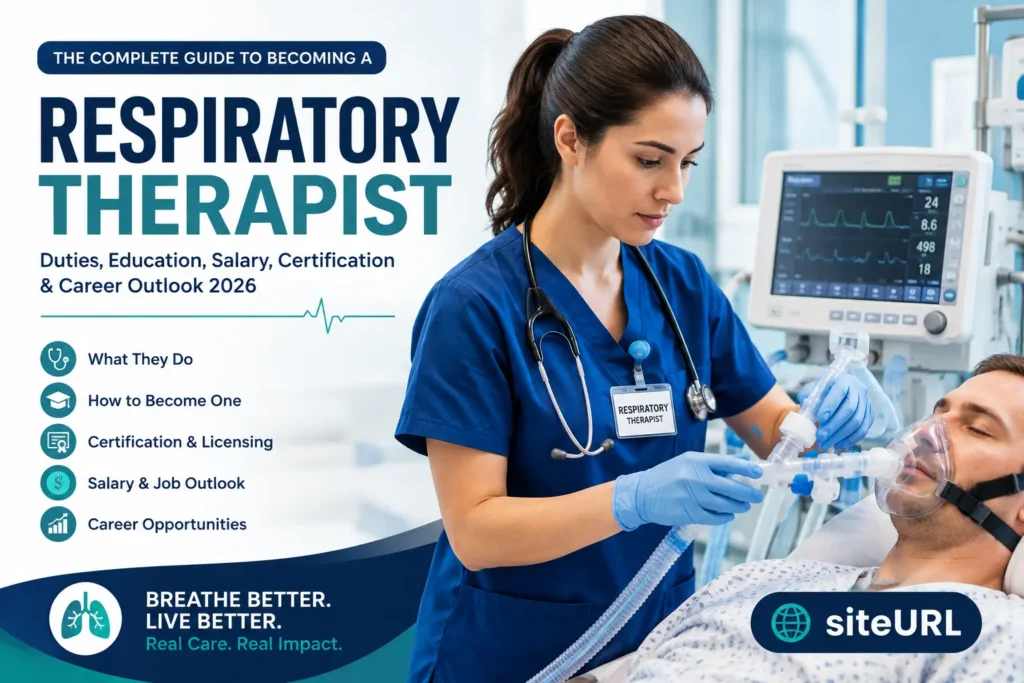
If you are considering a career in healthcare but do not want to spend many years in medical school, respiratory care is worth understanding. This profession focuses on the heart and lungs, breathing problems, emergency care, patient education, diagnostic testing, and the equipment used to support breathing.
The simplest way to think about the role is this: a respiratory therapist is a breathing-care specialist who works with patients across the lifespan, from premature newborns to older adults with complex lung disease. The job can involve routine treatment, long-term disease management, and high-pressure situations such as respiratory failure.
This guide explains what the profession involves, what education and credentials are needed, how state licensing works, what the pay looks like, where people work, and how the career compares with nursing and physician roles. It also explains the practical questions a new student is likely to have before choosing a program or applying for a job.
What Is a Respiratory Therapist?
A respiratory therapist is a licensed healthcare professional who evaluates, treats, and monitors people with breathing and cardiopulmonary problems. The work includes assessing a patient’s condition, performing respiratory tests, delivering prescribed therapies, operating respiratory equipment, monitoring response to treatment, and teaching patients how to manage their condition.
The occupation is classified by the U.S. Bureau of Labor Statistics under SOC 29-1126. O*NET describes the role as covering respiratory-care modalities, therapeutic procedures, patient records, equipment operation, and, in some settings, supervision of respiratory therapy technicians.
What makes this profession different from many other healthcare careers? The focus is narrower than general nursing but deep in one critical area: breathing and cardiopulmonary function. A patient may need help clearing secretions, receiving oxygen, using an inhaled medication, completing a lung-function test, or being supported by a mechanical ventilator. The exact scope depends on the workplace, state rules, credentialing, and the clinician’s training.
The title can also vary. You may see terms such as respiratory care practitioner, RCP, certified respiratory therapist, CRT, or registered respiratory therapist, RRT. These terms can describe related roles or credentials, but the licensing and credentialing rules should always be checked for the state and employer involved.
What Does a Respiratory Therapist Do?
What happens during a normal shift? There is no single routine. One shift may involve assessing several patients on a hospital floor, while another may center on intensive care, emergency response, neonatal care, pulmonary testing, or equipment management.
Typical work can include reviewing medical information, talking with patients, checking vital signs and respiratory status, carrying out ordered treatments, evaluating the response, documenting care, and communicating changes to the healthcare team.
Assess breathing status and cardiopulmonary function.
Perform or assist with diagnostic testing such as pulmonary function testing and arterial blood gas assessment.
Administer respiratory treatments and prescribed medications through appropriate delivery systems.
Set up, monitor, and troubleshoot mechanical ventilation and other respiratory equipment.
Provide oxygen therapy and help patients use oxygen-delivery devices safely.
Assist with airway management and emergency respiratory care within the clinician’s authorized scope.
Teach patients and caregivers about breathing techniques, medications, devices, and disease management.
Record treatment, measurements, patient response, and relevant clinical information.
Communicate findings and changes to physicians, nurses, and other members of the care team.
O*NET’s 2026 occupational profile lists emergency care, physiological monitoring, mechanical ventilator operation, patient education, equipment inspection, pulmonary testing, documentation, and collaboration with other healthcare professionals among the occupation’s core activities.
Respiratory Therapist Duties and Responsibilities
The responsibilities become easier to understand when they are grouped into four areas: assessment, treatment, monitoring, and education.
Patient assessment
Assessment means collecting information that helps the care team understand how well a patient is breathing. Depending on the setting, this can involve reviewing the medical history, observing breathing effort, checking oxygenation and vital signs, listening to breath sounds, reviewing test results, and identifying changes that require escalation.
Respiratory treatments
Treatment may include oxygen delivery, aerosol or nebulized medication, airway-clearance techniques, breathing exercises, and other respiratory-care procedures. The exact treatment is based on the patient’s condition, the clinical plan, and applicable scope-of-practice rules.
Ventilator and airway care
In critical care, the work can become highly technical. Mechanical ventilation supports patients who cannot breathe adequately on their own. The clinician may set up equipment, monitor patient response, identify problems, communicate changes, and help maintain safe respiratory support. Airway management responsibilities vary by facility and jurisdiction.
Monitoring and documentation
Respiratory care is not a one-time task. Patients must be reassessed to determine whether a treatment is working. Documentation can include measurements, treatments, patient response, equipment settings, and communication with the care team.
Patient education
A major part of the job is helping patients understand what they are doing and why. Someone going home with oxygen, for example, may need practical instruction about equipment, prescribed use, safety, and signs that require medical attention. Education can also cover inhaler technique, breathing exercises, airway clearance, or disease-management strategies.
Where Do Respiratory Therapists Work?
Hospitals are the largest employment setting in the United States. BLS reports that about 80% of jobs in 2024 were in hospitals, with smaller shares in nursing care facilities and physician offices.
Emergency departments, where rapid assessment and respiratory support may be needed.
Intensive care units, including adult critical care environments.
Neonatal intensive care units, where premature and medically fragile newborns may need specialized respiratory support.
Pediatric units for infants, children, and adolescents with breathing problems.
General inpatient units for acute and chronic respiratory conditions.
Nursing and skilled-care facilities.
Physician offices and outpatient clinics.
Pulmonary function laboratories and diagnostic centers.
Home healthcare and durable medical equipment-related services, depending on the role.
Pulmonary rehabilitation and other specialized cardiopulmonary programs.
The work setting affects the pace, patient population, equipment, schedule, and level of emergency response. Someone who prefers predictable outpatient care may have a very different experience from someone working in a busy intensive care unit.
Respiratory Therapist Education and Degree Requirements
In the United States, the typical entry-level education is an associate degree in respiratory therapy. BLS also notes that some employers prefer applicants with a bachelor’s degree. O*NET’s current occupation profile similarly reports an associate degree as the most common educational requirement among respondents.
A respiratory therapy program normally combines classroom learning, laboratory work, and supervised clinical experience. Common academic subjects include anatomy and physiology, cardiopulmonary science, pharmacology, microbiology, patient assessment, respiratory procedures, mechanical ventilation, and diagnostic testing.
What should you study before applying? Requirements vary by school, but common prerequisites can include biology, chemistry, algebra, physics, and other general education courses. Always check the individual program because admission requirements are not identical.
Clinical education matters because respiratory care is hands-on. Students need opportunities to practice assessment, equipment use, communication, infection-control procedures, documentation, and patient-care techniques under supervision.
How to Become a Respiratory Therapist
Complete the required high school or equivalent education and any program prerequisites.
Choose a respiratory therapy program that meets applicable accreditation and credentialing requirements.
Complete the academic, laboratory, and supervised clinical portions of the program.
Graduate with the required degree or educational credential.
Meet the eligibility requirements for the applicable national credentialing examination.
Earn the credential required or preferred by your state and intended employers.
Apply for state licensure where required.
Complete any state renewal, continuing-education, or other professional requirements.
Apply for positions that match your education, credentials, and scope of practice.
How long does the process take? The answer depends on the program, prerequisites, full-time or part-time enrollment, and credentialing pathway. An associate-level program can be completed in roughly two years after prerequisites in many cases, but the total timeline can be longer. A bachelor’s pathway takes longer and may be chosen for broader career development or employer preference.
The important point is that graduation and licensure are not necessarily the same event. You need to understand the credentialing and state-license requirements before assuming you can immediately practice after receiving your diploma.
Respiratory Therapist Certification and Licensing
Certification and licensure are related but not identical. Certification is a professional credential demonstrating that you have met a defined examination and eligibility standard. Licensure is the legal authorization to practice in a particular jurisdiction.
BLS states that practitioners must be licensed in every U.S. state except Alaska, although requirements differ. A state may recognize a national credential as part of its licensing pathway, but additional requirements can apply.
Before enrolling in a program, ask three questions: Does the program meet the educational requirements for the credential I want? Will graduation make me eligible for the examination pathway I need? Does the program prepare graduates for the state in which I intend to work?
This is especially important for people who plan to move between states. A credential may travel more easily than a state license, but the license itself is governed by the jurisdiction.
CRT vs. RRT: Respiratory Therapist Credentials
CRT means Certified Respiratory Therapist, while RRT means Registered Respiratory Therapist. Both are national credentials associated with respiratory care, but the RRT represents a higher credential level and is commonly preferred or required by employers.
As of 2026, the National Board for Respiratory Care describes a transition in its examination system. Through December 31, 2026, the Therapist Multiple-Choice examination, or TMC, uses two cut scores: the lower cut can award the CRT credential, while the higher cut can award CRT and establish eligibility for the Clinical Simulation Examination when other eligibility requirements are met.
The NBRC says the Clinical Simulation Examination is available through the end of 2027 under its current transition rules. Starting in January 2027, a new Respiratory Therapy Examination is scheduled to use two cut scores to determine whether a candidate receives CRT or RRT credentials.
Why does this matter to a student? Examination rules can change, and eligibility requirements are specific. A student should use the current NBRC rules for the planned examination date rather than relying on an older study guide or a social-media summary.
Respiratory Therapist Salary and Hourly Pay
How much can you earn? The latest BLS Occupational Outlook Handbook figures available in 2026 report a median annual wage of $80,450 for May 2024, equivalent to about $38.68 per hour when expressed as an hourly figure. The lowest 10% earned less than $61,900, while the highest 10% earned more than $108,820.
These are national wage statistics, not a guaranteed starting salary. Actual pay depends on location, experience, credentials, employer, shift, specialty, overtime, union or contract arrangements, and the local labor market.
BLS reported May 2024 median wages by major employment industry of $80,660 for hospitals, $75,910 for nursing care facilities, and $75,240 for offices of physicians.
What can raise total compensation? In some workplaces, night, weekend, holiday, overtime, charge, specialty, or other differentials can affect earnings. Those additions vary by employer and should not be treated as part of the national median.
Respiratory Therapist Salary by State
Location can make a substantial difference in compensation. BLS publishes state and metropolitan wage data separately, and the most recent national median should not be confused with the mean wage for a particular state or city.
For a practical comparison, the May 2023 BLS geographic profile showed mean annual wages of about $103,060 in California, $98,770 in New York, $95,240 in the District of Columbia, $94,590 in Alaska, and $93,820 in Washington. Those figures are older than the May 2024 national median and are included here only to illustrate geographic variation, not as the latest state ranking.
For a 2026 job search, compare the newest available state and metropolitan data rather than using an old national list. Cost of living also matters. A higher nominal wage does not automatically mean more disposable income.
Compare the local wage with housing and transportation costs.
Look at hospital systems and major employers in the area.
Check whether the job requires or rewards RRT credentials.
Compare base pay with shift differentials and overtime policies.
Look at benefits, retirement contributions, paid leave, and health coverage.
Check current local job postings because employer-specific pay can differ from statewide averages.
Respiratory Therapist Job Outlook and Career Opportunities
Is demand strong? Yes, according to current BLS projections. Employment is projected to grow 12% from 2024 to 2034, compared with 3% for all occupations. BLS projects about 8,800 openings per year on average over that period.
BLS projects employment to rise from about 139,600 jobs in 2024 to approximately 156,400 in 2034, an increase of about 16,800 positions.
Why is demand expected to continue? An aging population is associated with more respiratory conditions, including pneumonia and COPD. Demand can also be influenced by smoking-related disease, air pollution, emergencies, and efforts to manage patients in outpatient settings and reduce hospital readmissions.
A strong job outlook does not mean every graduate will receive the same offer. Location, credentials, clinical experience, communication skills, and the type of facility all influence employability.
Respiratory Therapist Skills and Qualities
Technical knowledge is only part of the job. A clinician can understand equipment and still struggle if they cannot communicate calmly with a frightened patient or recognize a changing clinical situation.
Critical thinking for interpreting patient information and deciding when a condition may be changing.
Attention to detail when checking treatments, measurements, documentation, and equipment.
Communication skills for explaining procedures and reporting important findings.
Compassion and patience for people who may be anxious, short of breath, or critically ill.
Problem-solving for equipment issues and unexpected changes in patient status.
Teamwork with physicians, nurses, technicians, and other healthcare professionals.
Adaptability because patient needs and clinical priorities can change quickly.
Stress tolerance for emergency and high-acuity environments.
Professional integrity and careful adherence to clinical and safety requirements.
O*NET’s 2026 profile highlights active listening, critical thinking, monitoring, speaking, active learning, service orientation, complex problem-solving, adaptability, attention to detail, dependability, empathy, and stress tolerance among relevant skills and work styles.
Respiratory Therapist Work Environment and Schedule
Most people in this occupation work full time. Hospitals operate around the clock, so shifts can include nights, weekends, and holidays. Some roles have more predictable daytime schedules, particularly in outpatient, diagnostic, rehabilitation, or office environments.
The physical side of the job should not be underestimated. BLS notes that workers may stand for long periods and may need to lift or turn patients. Exposure to infectious disease is another occupational consideration, so infection-control procedures and appropriate protective equipment are important.
What does a hospital shift feel like? It can involve frequent movement between patients, interruptions, urgent requests, equipment checks, documentation, and collaboration with several clinical teams. The pace can be very different from a scheduled outpatient setting.
People who thrive in this field often like science, hands-on work, direct patient contact, structured clinical procedures, and situations where careful decisions matter.
Respiratory Therapist Specialties
The profession offers several directions. Your specialty may be influenced by your employer, clinical experience, additional training, and personal interests.
Critical care: care for seriously ill patients who may need advanced respiratory support.
Neonatal care: specialized support for premature or medically fragile newborns.
Pediatric care: respiratory assessment and treatment for infants, children, and adolescents.
Emergency care: rapid response to acute breathing problems and medical emergencies.
Pulmonary function testing: diagnostic testing used to evaluate lung function.
Pulmonary rehabilitation: education, exercise, and disease-management support for selected patients.
Sleep-related care: assessment and support related to sleep-disordered breathing in appropriate settings.
Home respiratory care: support with respiratory equipment and chronic disease management outside the hospital.
Not every employer offers every specialty, and job titles can differ. The best way to evaluate a specialty is to look at the actual duties, credential requirements, patient population, and schedule attached to the position.
Respiratory Therapist Equipment and Technology
Modern respiratory care depends heavily on technology, but equipment is only useful when the clinician understands the patient behind the numbers.
Mechanical ventilators for patients who need assisted or controlled breathing support.
Oxygen-delivery systems used to provide supplemental oxygen through different interfaces.
Nebulizers and aerosol-delivery systems for certain inhaled treatments.
Pulse oximeters for noninvasive monitoring of oxygen saturation.
Arterial blood gas testing and related analysis used to assess oxygenation, ventilation, and acid-base status.
Pulmonary function testing equipment for measuring aspects of lung function.
Airway-management equipment used according to clinical need and authorized scope.
Electronic health records for documenting assessments, treatments, results, and patient response.
Equipment responsibilities can include selecting appropriate devices, setting them up, checking function, cleaning or maintaining equipment, recognizing problems, and communicating technical or clinical concerns. O*NET specifically lists mechanical ventilators, therapeutic gas systems, aerosol generators, diagnostic equipment, and equipment inspection among the occupation’s activities.
Respiratory Therapist vs. Registered Nurse
How is respiratory care different from nursing? The biggest difference is scope of focus. Registered nurses provide broad nursing care across many body systems and coordinate numerous aspects of patient care. Respiratory care concentrates more deeply on breathing, oxygenation, ventilation, airway management, pulmonary testing, and related therapies.
The two professions work closely together. A patient in intensive care may have both a nurse and a respiratory care clinician involved, with each bringing a different area of expertise.
Education and licensing also differ. BLS lists an associate degree as the typical entry-level education for this occupation, while its current profile for registered nurses lists a bachelor’s degree as the typical entry-level education. State rules and employer expectations should always be checked.
Which career is better? Neither is universally better. Choose based on whether you prefer a focused cardiopulmonary specialty or the broader scope of nursing practice.
Respiratory Therapist vs. Pulmonologist
A pulmonologist is a physician who specializes in diseases of the lungs and respiratory system. The educational pathway is therefore much longer and includes medical school and physician training.
A respiratory care clinician is not a physician. The role is hands-on and centered on respiratory assessment, treatments, monitoring, equipment, testing, and patient education within the applicable scope of practice.
They often work as part of the same team. A physician may diagnose disease and direct a broader medical plan, while the respiratory care professional contributes specialized respiratory assessment, treatment, monitoring, and technical expertise.
Explore more amazing, latest, and insightful articles Visit Kogniz Contact Tracing.
Respiratory Therapist vs. Respiratory Therapy Technician
These titles should not be treated as interchangeable. A respiratory therapy technician or assistant may perform duties under the supervision or direction of a qualified professional, depending on the facility and jurisdiction. The respiratory care professional typically has broader responsibility for assessment, treatment modalities, clinical decision-making within scope, documentation, and supervision.
O*NET specifically lists supervision of respiratory therapy technicians among the responsibilities associated with the occupation. Because titles and permitted duties can vary, always read the job description and state regulations rather than judging scope from the title alone.
Respiratory Therapist Jobs and Jobs Near Me
If you are searching for jobs near you, location changes the search strategy. Instead of searching only for the profession name, combine it with your city, state, hospital type, specialty, credential, and shift preference.
City + respiratory care jobs
State + respiratory care jobs
Hospital + RRT jobs
NICU respiratory care jobs
ICU respiratory care jobs
Pediatric respiratory care jobs
Travel respiratory care jobs
Night-shift respiratory care jobs
New graduate respiratory care jobs
For a new graduate, hospital systems and teaching hospitals can be useful places to investigate because they may offer structured orientation or a range of clinical departments. Experienced clinicians may have additional options in specialty units, outpatient care, home care, pulmonary diagnostics, education, leadership, or other settings.
What should you check before applying? Read the credential requirements, minimum experience, shift pattern, patient population, orientation period, weekend expectations, and pay structure. A job with a higher advertised base rate may not be the best fit if the schedule or commute is difficult.
Respiratory Therapist Requirements by State
State regulation is one of the most important areas to verify before choosing a program. BLS states that licensure is required in every state except Alaska, but the details vary.
A state may set requirements involving education, examination, application documentation, fees, background checks, continuing education, renewal, or other professional conditions. Some states may use different terminology or have specific requirements for temporary or initial licenses.
If you plan to move, do not assume your current license automatically transfers. Look at the destination state’s licensing board requirements before accepting a job or relocating.
Confirm the state board responsible for respiratory care or allied health licensing.
Check the current educational requirement.
Confirm which examination or national credential is accepted.
Review application and background-check requirements.
Check renewal periods and continuing-education rules.
Ask whether the state has additional jurisprudence, jurisprudence-style, or state-specific requirements.
Verify rules directly with the licensing authority before making a career or relocation decision.
Is Respiratory Therapist a Good Career in 2026?
For many people, yes. The profession combines a relatively short educational pathway with strong projected employment growth, meaningful patient contact, technical skills, and opportunities to work in different clinical environments.
The numbers support the career’s current strength: BLS reports a $80,450 median annual wage for May 2024 and projects 12% employment growth from 2024 through 2034. The occupation is also included in the 2026 BLS discussion of healthcare careers that do not typically require a four-year degree.
But a good career is not only about salary. Consider the realities of the work: shift schedules, exposure to illness, physical demands, emotionally difficult cases, continuing education, and responsibility around complex equipment.
Who is likely to enjoy it? Someone who likes biology and medicine, wants direct patient contact, enjoys practical problem-solving, can stay calm under pressure, and wants a specialized healthcare role without the length of physician training may find it a strong fit.
Who may dislike it? Someone who strongly prefers predictable office hours, minimal patient contact, or work without emergency situations may find hospital-based respiratory care challenging.
Respiratory Therapist Career Path
A career can develop in several directions after the first clinical position. The common starting point is entry into patient care after completing the required education, credentialing, and state licensing steps.
Student in an accredited respiratory care program.
New graduate preparing for credentialing and licensure.
Entry-level clinician developing bedside and technical experience.
Experienced clinician working in areas such as critical care, neonatal, pediatric, diagnostics, rehabilitation, or home care.
Senior or lead clinician taking on additional responsibilities.
Educator, clinical preceptor, coordinator, manager, or other advanced professional role where qualifications and employer structure allow.
An RRT credential can also strengthen professional mobility and meet employer expectations for positions that require or prefer the higher credential. Additional education, leadership experience, teaching ability, specialized clinical experience, and employer-specific training can open further opportunities.
The smartest long-term plan is not simply to collect credentials. Build a combination of clinical competence, communication, documentation, technology skills, professional reliability, and continuing education that matches the direction you want to take.
FAQs
What is the difference between respiratory care and respiratory therapy?
The terms are often used interchangeably in the United States. Respiratory care is the broader name for the clinical services and specialty, while respiratory therapy commonly describes the profession and its treatments. Job titles and terminology can vary by employer and state.
Can you become a respiratory care professional with an associate degree?
Yes. An associate degree is the typical entry-level education reported by BLS. You must still meet applicable credentialing and state licensing requirements before practicing.
How long is respiratory therapy school?
Many associate-level programs are designed around roughly two years of professional study, but prerequisites and clinical requirements can extend the total timeline. Bachelor’s pathways take longer.
Is RRT better than CRT?
RRT represents a higher national credential level than CRT and is commonly preferred by employers. However, the credential you need depends on your state, employer, and career goals. Examination pathways are also changing, so candidates should follow current NBRC rules.
Do respiratory care clinicians work in the ICU?
Yes. Intensive care is one of the major clinical environments for the profession. The work can include ventilator management, respiratory assessment, monitoring, emergency support, and coordination with physicians and nurses.
Can respiratory care clinicians work with newborns?
Yes. Neonatal care is an important specialty. Clinicians in neonatal intensive care may care for premature or critically ill newborns who need specialized respiratory support.
Do they only treat people with asthma?
No. Asthma is only one example. Patients may have COPD, pneumonia, respiratory failure, sleep-related breathing problems, postoperative complications, neuromuscular conditions, or other cardiopulmonary disorders.
Is the job physically demanding?
It can be. Hospital clinicians may stand for long periods and may need to help lift or turn patients. The physical demands vary by workplace and role.
Can you work nights and weekends?
Yes. Hospital facilities operate around the clock, so full-time positions may include nights, weekends, and holidays. Some outpatient roles have more conventional schedules.
What skills are most important?
Critical thinking, attention to detail, communication, monitoring, teamwork, empathy, adaptability, and technical competence are especially important. O*NET’s 2026 occupational profile also highlights active listening, problem-solving, and stress tolerance.
Is a bachelor’s degree required?
Not typically for entry into the occupation. BLS identifies an associate degree as the typical entry-level education, although some employers prefer a bachelor’s degree. Individual program and employer requirements can differ.
Can a license transfer between states?
Do not assume it will transfer automatically. Licensure is state-specific, and requirements differ. Check the destination state’s current licensing rules before relocating.
What is the current salary?
The latest BLS national figure available in 2026 is a $80,450 median annual wage for May 2024, or about $38.68 per hour. Local pay can be substantially different.
Conclusion
A career in respiratory care is a specialized path into healthcare for people who want to combine science, technology, hands-on treatment, and direct patient care. The role covers far more than giving oxygen: it can involve assessment, diagnostic testing, emergency response, mechanical ventilation, patient education, equipment management, and long-term disease support.
The most important decisions come before the first job. Choose an appropriate education program, understand the credentialing pathway, verify the licensing rules for the state where you plan to practice, and decide which clinical environment fits your personality and goals.
For 2026, the career outlook is encouraging. BLS projects 12% employment growth from 2024 to 2034, with about 8,800 openings per year on average. The national median wage was $80,450 in May 2024. Those figures make the field attractive, but the best choice is the one that also fits your preferred schedule, clinical interests, tolerance for high-acuity work, and long-term career plans.
If you approach the profession with the right expectations, build strong clinical skills, keep your credentials current, and continue learning as respiratory technology changes, you can create a durable healthcare career with multiple directions for growth.
2026 Content & Search Intent Coverage
Direct-answer definitions designed for answer engines and AI-generated search summaries.
Question-led explanations that address beginner, career, salary, education, licensing, comparison, and local-intent searches.
Entity-rich coverage including BLS, O*NET, NBRC, CRT, RRT, TMC, CSE, mechanical ventilation, pulmonary function testing, oxygen therapy, cardiopulmonary care, ICU, NICU, outpatient care, state licensing, and healthcare education.
Local-search considerations covering state licensing, state wages, metropolitan variation, job searches, and relocation concerns.
Original practical guidance on choosing programs, comparing jobs, evaluating compensation, and planning a career path.
Clear distinctions between certification and licensure and between respiratory care, nursing, physician, and technician roles.
2026 credentialing transition information so readers are not relying on outdated examination descriptions.
Factual Sources Used for 2026 Verification
U.S. Bureau of Labor Statistics, Occupational Outlook Handbook: Respiratory Therapists; BLS Occupational Employment and Wage Statistics; BLS 2026 Career Outlook; O*NET OnLine occupation 29-1126, updated 2026; National Board for Respiratory Care examination and credential information. Figures and regulatory statements should be rechecked against the applicable authority when a reader is making a licensing, education, or employment decision.
Explore more amazing, latest, and insightful articles Visit Eevee Evolutions.