If you are completely new to this comic, the easiest way to understand it is to forget the assumption that every Batman story begins with a billionaire living in Wayne Manor. This version starts from a different foundation. Bruce Wayne is still driven by the same basic desire to protect people, but his resources, upbringing, relationships, and path to becoming a vigilante are substantially different.
That change affects almost everything around him. Gotham is harsher, the supporting cast has been reworked, familiar villains have new roles, and characters who normally stand beside the Dark Knight can become threats. The result is not simply a costume change; it is a deliberate reconstruction of the Batman formula inside DC’s Absolute Universe.
This guide focuses on information available in 2026 and separates established comic-book facts from announcements about the television project. It also explains how a new reader can approach the material without needing years of previous DC Comics knowledge.
What Is Absolute Batman?
This is a DC Comics ongoing series that reimagines Bruce Wayne and the Batman mythology in a separate continuity associated with the Absolute Universe. The series is written by Scott Snyder and illustrated primarily by Nick Dragotta, with other artists contributing to individual issues. It launched in 2024 and quickly became one of the central titles in DC’s new line.
The defining idea is simple: remove the traditional advantages and see what kind of Batman remains. There is no Wayne Manor functioning as his headquarters, no inherited fortune solving every logistical problem, and no requirement that this Bruce follow the same life path as his mainstream counterpart. He is a working-class hero whose physical training, engineering ability, determination, and relationships become much more important.
Why does that matter? Because Batman has traditionally been a character whose effectiveness comes from a combination of money, preparation, technology, detective work, combat skill, and psychological discipline. Removing one major pillar forces the story to explore the others in much greater detail.
Absolute Batman Story and Origin
Bruce’s origin is recognizable in its emotional foundation but different in its circumstances. The story still centers on Gotham, crime, loss, family, and the decision to fight back against systems that allow violence to flourish. What changes is the environment that shapes Bruce before he becomes the masked vigilante.
Instead of inheriting a vast corporate fortune, Bruce grows up without the financial safety net normally associated with the Wayne family. His practical knowledge and physical toughness are therefore developed for real-world reasons rather than simply as preparation for a future life of crime fighting.
His engineering background is especially important. It gives the character a believable way to create, repair, and modify equipment without turning every solution into a purchase from Wayne Enterprises. His intelligence is expressed through making things work, improvising, and understanding how systems can be exploited.
The early story also establishes that becoming a hero is not a one-time transformation. Bruce has to keep adapting because the threats around him are designed to exploit his weaknesses. That approach makes each new confrontation part of his development rather than just another fight.
What makes the origin different from the familiar version? The emotional motivation remains recognizable, but the social and economic circumstances are changed. The series uses those differences to ask what Batman means when wealth and inherited privilege are removed from the equation.
Absolute Batman Characters
The cast combines recognizable names with significantly altered histories. New readers should think of these characters as alternate versions rather than assuming that every biography from the main DC continuity carries over.
Bruce Wayne is the central figure, but the surrounding cast is essential to understanding this world. Alfred Pennyworth, the Robins, Gotham’s criminal figures, and Bruce’s friends all occupy different positions than readers may expect.
The series is particularly interested in relationships. A familiar character can feel completely different when the person who normally mentors them, fights beside them, or becomes their enemy has been changed. This is one of the most important storytelling tools in the Absolute Universe.
Key semantic entities and recurring concepts include Gotham City, Bruce Wayne, Alfred Pennyworth, the Joker, Bane, Scarecrow, Catwoman, the Robins, Ark M, the Absolute Universe, and the broader DC Comics mythology.
Absolute Batman Bruce Wayne
This Bruce Wayne is defined less by inherited wealth and more by work, physical conditioning, engineering knowledge, and an unusually strong willingness to put himself in danger. His body is portrayed as a major part of his toolkit, and his fighting style is more physically imposing than the leaner image many readers associate with traditional Batman.
His lack of wealth changes the practical side of vigilantism. Equipment has to be designed, built, repaired, or acquired with far greater care. A damaged tool is not automatically replaced, and a failed plan can carry a greater cost.
The working-class interpretation also changes how Bruce relates to Gotham. He is not an outsider who returns to a city that his family once dominated economically. He is much closer to the people and environments he is trying to protect, which gives the series a different social perspective.
Does that make him a weaker Batman? Not necessarily. It makes his strengths different. Preparation remains important, but creativity, engineering, endurance, improvisation, and direct physical ability become more prominent.
Absolute Batman vs. Batman
The easiest comparison is not to ask which version is stronger in every situation, but to identify what each version is built around. Mainline Bruce Wayne traditionally has enormous financial resources, extensive institutional connections, established allies, and decades of accumulated equipment and experience across many stories.
The alternate Bruce starts with far fewer material advantages. His resources are constrained, his world is unfamiliar to longtime Batman readers, and many relationships that seem permanent in the classic mythology are either absent or radically transformed.
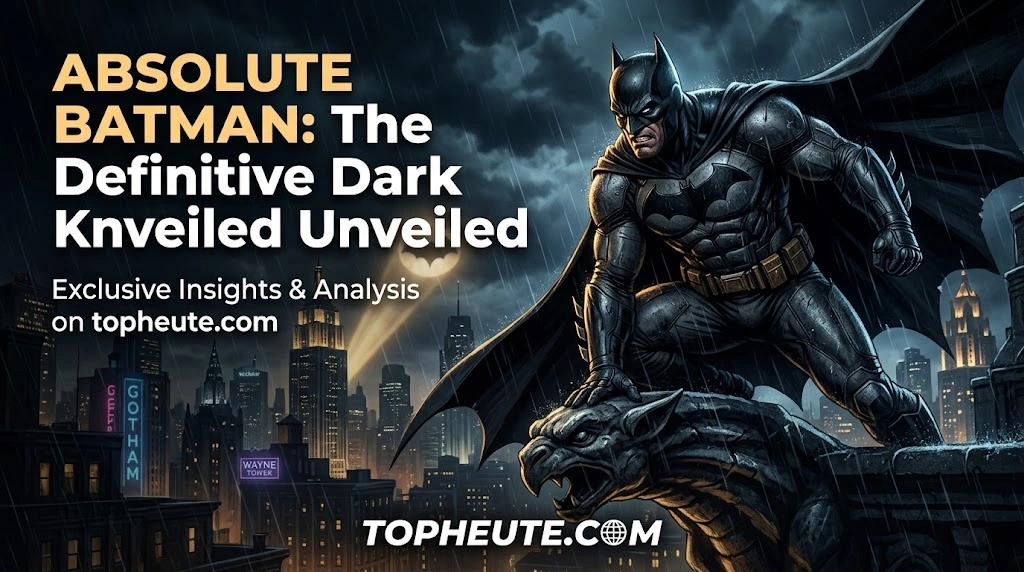
Their visual designs also communicate different ideas. The familiar Batman silhouette is often associated with stealth, precision, and technological sophistication. The newer design emphasizes mass, movement, a dramatic cape, and a more aggressive physical presence.
The similarities are just as important. Both versions rely on determination, detective thinking, combat ability, fear as a weapon, and a commitment to protecting Gotham. The contrast works because the underlying idea of Batman remains recognizable even when the circumstances change.
Absolute Batman and the Absolute Universe
The Absolute Universe is DC’s alternate publishing continuity built around radical reinterpretations of familiar heroes. It includes versions of major characters whose origins, resources, supporting casts, and conflicts can differ substantially from their mainstream counterparts.
Other important titles include Absolute Superman, Absolute Wonder Woman, Absolute Flash, Absolute Green Lantern, Absolute Green Arrow, and other related books. Each title explores the same broad creative principle: take a familiar heroic identity and rebuild the conditions surrounding it.
This matters for readers because the series does not exist in isolation. The broader continuity creates opportunities for connections between titles, while still allowing individual books to work as entry points. You can start with the Batman title without first reading every other Absolute series.
A useful way to think about the setting is as a parallel version of DC mythology rather than a replacement for the main continuity. Familiar names can appear, but their histories should not automatically be assumed to match the versions readers already know.
Absolute Batman Villains
The villains are not simply recycled versions of classic enemies. Their identities, histories, alliances, and relationships with Gotham can be redesigned to fit the new world.
The Joker is especially important because his position in the mythology is recontextualized. The story uses the character not merely as a chaotic enemy but as part of the larger question of who gets to shape Gotham’s young people and what happens when mentorship is corrupted.
Bane is another major figure. His presence is tied to the larger mystery surrounding Ark M and Alfred’s history. His physical threat also fits naturally into a story where Bruce is being pushed toward his limits.
Scarecrow becomes central during the later 2026 storyline. The Straw Man arc brings together the Batman mythology, the Robins, and psychological danger in a way that makes the conflict broader than a simple hero-versus-villain encounter.
Other familiar concepts and characters can be reworked as the series continues. For readers, the important rule is to treat each appearance as part of this continuity rather than importing assumptions from the main DC Universe.
Absolute Batman Suit and Equipment
The suit is one of the most immediately recognizable differences. The broad silhouette, oversized cape, pronounced shoulders, and prominent design elements make this version look physically imposing before he even moves.
The cape is more than decoration. Its scale contributes to the character’s visual identity and can be used dynamically during movement and combat. The overall design also makes the character appear larger and more threatening, which supports the series’ more aggressive physical approach.
Technology is handled differently because Bruce does not have unlimited access to corporate laboratories. Engineering and fabrication become part of the storytelling. Equipment feels like something a capable person has designed for a purpose rather than a catalog of expensive gadgets.
The same principle applies to transportation and tools. Readers should pay attention not only to what a device does but to why Bruce needs it, how he built or obtained it, and what happens when it fails. This makes the technology feel connected to character development rather than being independent spectacle.
Absolute Batman Reading Order
For a new reader, the simplest approach is publication order. Start with the first six issues, continue through the next collected arc, then add the annual and Ark M special at the point where they fit into the published story.
The major collected reading sequence in 2026 is straightforward: Volume 1 collects issues #1–6; Volume 2 collects #7–14; Volume 3 collects the 2025 Annual, Ark M #1, and issues #15–18; and the next collection covers the Straw Man material beginning with #19.
Publication order is particularly useful because Ark M adds background information that connects to the ongoing mystery. Reading it around the point it was published gives the surrounding events more context than simply jumping to it at the end.
Absolute Batman Issue Guide
The series began with a six-issue opening story that establishes the alternate Gotham, Bruce’s origin, his methods, and the core cast. The next group expands the mythology and introduces the mystery surrounding Ark M, Bane, Alfred, and the Joker.
Issues #15–18 continue the story into material connected with Devil’s Workshop and the larger secrets surrounding the setting. The 2025 Annual and Ark M special provide additional context rather than functioning as random side stories.
Issues #19–23 form the Straw Man storyline. This sequence introduces the Absolute Robins in a major way and changes the relationship between Batman and characters who would traditionally be his protégés. By issue #23, the conflict has reached a major confrontation involving Batman, the Robins, and the consequences of their altered histories.
Because the series is ongoing, an issue guide should always be treated as a living section. New releases can add chapters, change character relationships, and reveal information that alters the meaning of earlier events.
Absolute Batman #1–23
As of September 2026, the main series has reached issue #23. DC lists #23 with a release date of August 12, 2026, written by Scott Snyder with art by Nick Dragotta. The issue continues the Straw Man storyline and centers on an intense confrontation involving Batman and the Robins.
Issues #19–23 are particularly important for understanding the current status of the story. They introduce and develop the Absolute versions of Dick Grayson, Jason Todd, Tim Drake, Stephanie Brown, and Duke Thomas as a coordinated Robin group connected to Jack Grimm and trained by Slade Wilson.
Issue #20 escalates the conflict, while #21 pushes the confrontation further. The later chapters continue the consequences through the fifth part of the arc. New readers should avoid treating these issues as a simple alternate-costume story; the Robin concept itself has been rebuilt.
The numbering also helps with collecting. If you want the original monthly experience, read #1 through #23 in order. If you prefer larger story blocks, use the collected editions and insert the annual and Ark M material according to publication sequence.
Absolute Batman Story Arcs
The series is easier to follow when grouped into major story arcs. The early material establishes the world and Batman’s approach. The Abomination period expands the cast and introduces the Ark M mystery. Devil’s Workshop develops the mythology further, while the Straw Man storyline moves the focus toward the Robins and the consequences of their upbringing.
Story arcs matter because the title is designed as a continuous narrative. A reader who jumps randomly between issues may understand individual fights but miss why a character is present or why a particular revelation matters.
The arcs also show the series’ evolution. Early chapters concentrate on establishing a radically different Bruce Wayne. Later chapters increasingly ask what happens when the familiar Batman family is recreated without Batman occupying his usual role.
Absolute Batman and the Absolute Robins
The Absolute Robins are one of the biggest developments of 2026. Dick Grayson, Jason Todd, Tim Drake, Stephanie Brown, and Duke Thomas appear as members of a specially formed Robin Program rather than as Bruce Wayne’s traditional protégés.
Their mentor is not Batman. The group is connected to Jack Grimm, while Slade Wilson is involved in their training. That single change has enormous consequences because mentorship is one of the most important themes in Batman mythology.
Instead of learning discipline, restraint, and responsibility from Bruce, these versions have been shaped by a far darker environment. Their advanced armor and weapons make them a serious physical threat, while their different personalities show how familiar characters can change when their formative relationships change.
This is also why the Robin storyline is more than fan service. It is a direct experiment in nature, nurture, mentorship, and identity. The question is not simply what these characters look like; it is what they become when Batman is removed from their formative years.
Explore more amazing, latest, and insightful articles Visit:homepod mini
Absolute Batman: Ark M
Ark M is a mysterious facility that becomes important to the larger mythology. The dedicated Ark M special, released January 7, 2026, explores the origins of the facility and the secrets connected to it.
The special was written by Scott Snyder and Frank Tieri with art by Joshua Hixson. It provides additional background that helps explain why Ark M matters and why its residents are important to the wider story.
For new readers, Ark M can initially feel like a mystery box. The best way to understand it is as part of the series’ larger investigation into hidden systems, experiments, identities, and the history connecting Alfred, Bane, and other major players.
It is therefore useful to read the special near the point where it appears in publication order rather than treating it as a completely separate Batman story.
Absolute Batman Annual and Special Issues
Annual and special issues can provide information that a monthly chapter does not have room to explore. The 2025 Annual is part of the collected material associated with the third volume, alongside Ark M and issues #15–18.
These stories should not be ignored simply because they are not numbered as regular monthly issues. In an interconnected modern comic, a one-shot can explain a character, location, or event that becomes relevant later.
For readers who want only the core numbered issues, they can continue from #1 onward. For readers who want the most complete narrative experience, adding the annual and Ark M special gives a fuller picture of the world.
Absolute Batman Collected Editions
Collected editions are often the easiest format for new readers because they package several connected issues together. Volume 1, The Zoo, collects #1–6. Volume 2, Abomination, collects #7–14.
Volume 3, Devil’s Workshop, was released September 8, 2026. DC states that it collects the 2025 Annual, Ark M, and #15–18. This makes it an important bridge between the earlier material and the Straw Man storyline.
A future volume covering the Straw Man material is the natural continuation for readers who want #19 onward in a single book. Because publishing schedules can change, readers should check the latest edition information before assuming a future collection has already been released.
The practical advantage of collected editions is continuity. Instead of remembering individual release dates, a reader can move from one volume to the next while keeping the story arc intact.
Absolute Batman Animated Series
In June 2026, DC Studios and Warner Bros. Animation announced an adult animated series based on the comic. Scott Snyder is attached as executive producer and showrunner, while Nick Dragotta is involved as a producer. The project is in development.
No release date or network or streaming platform has been officially announced. That distinction matters because many online pages may describe the project as if it already has a scheduled premiere. As of September 2026, the confirmed status is development, not a released or dated series.
Snyder has also described the adaptation as an expansion of the comic rather than a simple one-to-one transfer. The creative team has been working on the series format and broader structure, while aiming to retain the core identity and visual spirit of the source material.
For viewers who have never read the comics, the animated project may eventually become an entry point. For now, the comic remains the established source material and the television version should be treated as an upcoming adaptation in development.
Absolute Batman Release Date and 2026 Updates
The comic launched in October 2024 and continued as an ongoing monthly-style series. By September 2026, DC’s official series listing includes issues through #23, with #23 released August 12, 2026.
The 2026 publication year has been significant because it includes the Ark M special, issues #16 through #23, the introduction of the Absolute Robins, and the Straw Man storyline. It also brought the third collected volume to stores.
The biggest screen-related update arrived in June, when the animated adaptation was announced at the Annecy International Animation Film Festival. The project remains in development, so a release date should not be presented as confirmed.
Another notable 2026 event is Batman Day on September 19, which includes Batman of Two Worlds, a special featuring both a mainline Batman story and a new story set in the this series world. This provides a useful example of how DC is presenting different Batman interpretations side by side.
What should readers watch next? The ongoing comic, future issue announcements, collected editions, and official updates about the animated project are the most meaningful indicators. Rumored casting, speculative release dates, and fan-made adaptation details should not be confused with confirmed information.
Is Absolute Batman Canon?
The answer depends on what is meant by canon. This version is official DC Comics continuity within the Absolute Universe, but it is not simply another chapter of the standard mainline Batman continuity.
In practical terms, readers should treat the setting as its own continuity with its own versions of characters, histories, and rules. A detail established here does not automatically rewrite the traditional Bruce Wayne mythology.
This separate-continuity structure is one reason the concept works so well for new readers. You do not need to know every event from decades of Batman comics to understand the premise. At the same time, longtime readers can appreciate how familiar ideas are being transformed.
Is Absolute Batman in a Different Universe?
Yes. The series takes place within DC’s Absolute Universe, a distinct continuity designed to reimagine established DC characters. It shares recognizable mythology with the broader DC brand while changing the circumstances that define its heroes and villains.
That means the name Bruce Wayne still carries meaning, but his biography is not identical to the version found in the primary DC continuity. The same principle applies to characters such as the Joker, Bane, Alfred, and the Robins.
The easiest mental model is to imagine a new set of rules applied to familiar building blocks. Gotham is still Gotham, Batman is still Batman, and the core themes remain recognizable, but the relationships and origin stories can be rebuilt from the ground up.
Where to Start Reading Absolute Batman
If you know nothing about the series, begin with issue #1. Do not start with the newest issue simply because it is the most current. The opening chapters establish Bruce’s circumstances, his equipment, his relationship with Gotham, and the storytelling rules of this universe.
For readers who prefer books, start with Volume 1: The Zoo, then Volume 2: Abomination, followed by Volume 3: Devil’s Workshop. After that, continue into the Straw Man material beginning with #19 when the corresponding collection becomes available.
If you want the most complete experience, include the 2025 Annual and Ark M at their publication position. If your goal is simply to understand the main plot, the numbered series remains the essential path.
Do you need to read Absolute Superman or Absolute Wonder Woman first? No. Those books expand the wider setting, but the Batman series is designed to establish its own characters and conflict. Cross-title reading becomes useful when you want a broader understanding of the Absolute Universe.
Why Is Absolute Batman Different From Traditional Batman?
The biggest difference is the removal of inherited wealth and the supporting infrastructure normally associated with Bruce Wayne. That single change affects his home, equipment, relationships, training, and connection to Gotham.
The second difference is the treatment of Batman as a working-class hero. His identity is not separated from ordinary life by a billionaire lifestyle. That creates a closer connection between the hero and the communities around him.
The third difference is the supporting cast. Characters who traditionally become members of the Bat-Family can have entirely different mentors, motivations, and moral frameworks. The Absolute Robins are the clearest example.
The fourth difference is visual and physical. The character is larger, more imposing, and more openly brutal in combat. His equipment is designed around practical limitations, while his engineering skills help compensate for the absence of unlimited resources.
Finally, the story treats Batman mythology as something that can be rebuilt rather than merely remixed. The familiar names are starting points for new questions about power, class, mentorship, family, fear, justice, and responsibility.
Absolute Batman Frequently Asked Questions
Is this a completely new Batman story?
It is a new continuity and a new interpretation of Bruce Wayne, but it deliberately uses recognizable Batman mythology as its foundation. You can read it without knowing the full history of the mainline character.
Who created the series?
Scott Snyder writes the series and Nick Dragotta is its principal artist. Their collaboration is central to the tone, visual identity, and world-building of the book.
Is Bruce Wayne still a billionaire?
No. One of the defining changes is that this Bruce does not have the traditional Wayne fortune and mansion. His resources and background are substantially different.
Does this version have Robin?
Yes, but the concept is radically different. The 2026 Straw Man storyline introduces the Absolute Robins, including alternate versions of Dick Grayson, Jason Todd, Tim Drake, Stephanie Brown, and Duke Thomas.
Who is the main villain?
There is no single villain who defines the entire series. Different arcs emphasize different threats, including figures connected with Gotham, Ark M, Bane, the Joker, Scarecrow, and the Robin Program.
What is Ark M?
Ark M is a mysterious facility tied to important secrets in the story. A dedicated 2026 special explores its origins and adds context to the ongoing mystery.
How many issues are available in 2026?
As of September 2026, DC’s official series listing reaches issue #23. The series is ongoing, so the number will continue to change as new issues are published.
What is the Straw Man storyline?
It is the major storyline spanning issues #19–23 and focuses heavily on the Absolute Robins, their relationship to Gotham, and their confrontation with Bruce.
Is there an animated adaptation?
Yes. DC Studios and Warner Bros. Animation announced an adult animated adaptation in June 2026. Scott Snyder is attached as executive producer and showrunner, with Nick Dragotta as a producer. No release date or platform has been announced.
Do I need to read other Absolute Universe books first?
No. The Batman series can be read on its own. Other Absolute titles can add context about the wider setting, but they are not a prerequisite for understanding Bruce’s story.
Is the animated series already released?
No. As of September 2026, it is in development. Readers should not treat an unconfirmed premiere date, voice cast, or platform as official.
Conclusion
This reimagined Batman works because it changes the circumstances without removing the ideas that make the character recognizable. Bruce Wayne is still driven by a determination to confront crime and protect Gotham, but his path is shaped by different resources, relationships, and social conditions.
For a new reader, the best entry point is issue #1 or the first collected volume. From there, the story expands through the early Gotham material, the Ark M mystery, Bane and other major threats, the Devil’s Workshop material, and the Straw Man storyline featuring the Absolute Robins.
By September 2026, the comic has reached #23, the third collected volume is available, and an adult animated adaptation is in development. That makes this a rapidly expanding corner of DC Comics, but the most important thing to remember is simple: this is a distinct continuity designed to ask what Batman becomes when the usual advantages are removed.
For readers who want a Batman story that combines familiar mythology with a substantially rebuilt world, the series offers enough new material to stand on its own while still rewarding fans who recognize the characters and themes being transformed.
Editorial SEO note: Secondary semantic terms were incorporated naturally throughout the article, including DC Comics, Absolute Universe, Bruce Wayne, Gotham City, Scott Snyder, Nick Dragotta, Alfred Pennyworth, Joker, Bane, Scarecrow, Robins, Robin Program, Ark M, Straw Man, Devil’s Workshop, Abomination, The Zoo, reading order, collected editions, graphic novels, animated series, DC Studios, and Warner Bros. Animation. Search-volume figures were not fabricated because no reliable keyword-volume dataset was supplied; terms were selected by topical relevance and search intent.
Explore more amazing, latest, and insightful articles Visit:pharmacy technician