
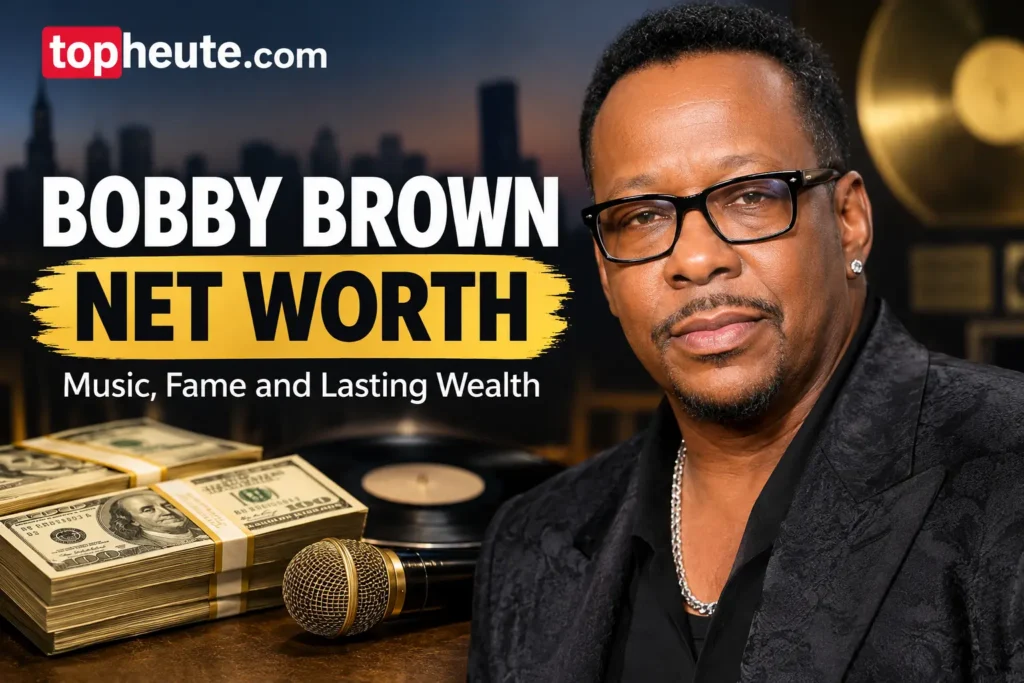
Bobby Brown is an American R&B singer, songwriter, dancer, and entertainer who became famous as a member of New Edition before building a successful solo career. His distinctive style, energetic performances, and hit songs helped define the new jack swing era of the late 1980s and early 1990s. Decades later, his music career, personal history, and connection to Whitney Houston continue to attract public interest.
The topic of bobby brown net worth raises an interesting question: how does an artist who achieved major commercial success maintain wealth long after his biggest hits? Brown’s financial story includes album sales, live performances, music royalties, television appearances, and business ventures, alongside personal challenges and financial obligations.
As of October 2026, bobby brown net worth is estimated at approximately $2 million, according to Celebrity Net Worth. This is a third-party estimate, not an audited financial statement. His complete assets, liabilities, royalty arrangements, and business interests are not publicly available, so the figure should be treated as an approximation rather than a confirmed account of his finances.
Understanding his financial position requires looking beyond his most successful records. His early career with New Edition, breakthrough solo album Don’t Be Cruel, continued live performances, and complicated family history all help explain his journey from teenage music star to an established veteran performer.
Bobby Brown Net Worth in 2026: Latest Estimate
Bobby Brown’s estimated net worth in 2026 is approximately $2 million. The figure published by Celebrity Net Worth reflects an estimate of his overall financial position, but it does not provide a complete breakdown of his assets, debts, or annual earnings.
Brown’s financial history is particularly interesting because his commercial success was substantial. His 1988 album Don’t Be Cruel became a major hit, and his recordings helped establish him as one of the most recognizable male R&B performers of his generation.
However, commercial success and personal wealth are not the same thing. An album can generate millions of dollars in sales while the artist receives only a portion of the revenue. Record labels, distributors, publishers, songwriters, producers, promoters, and other parties may also receive payments.
Brown’s income opportunities have changed over time. During his peak years, recording contracts and hit singles were central to his career. In later years, live appearances, New Edition reunions, television projects, and potential music royalties became important parts of his professional activity.
His current financial position cannot be calculated simply by adding together reported album sales or concert revenue. The amount he retained after contractual deductions, taxes, business expenses, and other obligations is not fully known.
The $2 million estimate is therefore best understood as a reported benchmark. It offers a general indication of his estimated wealth without establishing precisely how much money he currently has or earns each year.
Bobby Brown Net Worth: Quick Facts and Personal Profile
Here are the essential facts about the singer’s background, career, and financial profile.
| Detail | Information |
|---|---|
| Full name | Robert Barisford Brown |
| Professional name | Bobby Brown |
| Date of birth | February 5, 1969 |
| Age in 2026 | 57 years |
| Birthplace | Boston, Massachusetts, United States |
| Nationality | American |
| Profession | Singer, songwriter, dancer, entertainer |
| Music genres | R&B, new jack swing, pop |
| Former group | New Edition |
| Breakthrough solo album | Don’t Be Cruel |
| Famous songs | “My Prerogative,” “Every Little Step,” “Humpin’ Around” |
| Grammy Awards | One win |
| Former spouse | Whitney Houston |
| Current spouse | Alicia Etheredge-Brown |
| Children | Seven |
| Reported net worth estimate | Approximately $2 million in 2026 |
Brown’s career began when he was young, giving him decades of experience in the entertainment industry. His success with New Edition introduced him to a national audience, while his solo recordings helped him establish an individual identity.
His personal life has also been closely followed by the media. His marriage to Whitney Houston, his family responsibilities, and several difficult periods in his life have become part of the public narrative surrounding him.
Nevertheless, his financial position should be assessed separately from sensational headlines. His music, performances, business activities, contractual arrangements, and financial obligations provide a more useful framework for understanding his estimated wealth.
How Is Bobby Brown’s Net Worth Calculated?
Net worth represents the difference between a person’s assets and liabilities.
The basic formula is:
Net worth = Total assets − Total liabilities
Assets may include cash, investments, real estate, business ownership, and valuable contractual rights. Liabilities may include loans, unpaid taxes, legal obligations, and other outstanding debts.
For an entertainer, calculating net worth is especially complicated because income can vary considerably from year to year. A successful concert tour may generate substantial revenue, while the following year may involve fewer performances and lower earnings.
Music rights introduce another layer of complexity. An artist may perform a song without owning its recording or publishing rights. The performer might receive royalties under a contract, while other parties receive separate payments.
Celebrity net worth estimates generally rely on information available through public reporting, known career achievements, business activities, and estimates of assets or obligations. Unless an artist publishes detailed financial statements, the resulting figure cannot be considered definitive.
Several factors affect the reliability of Brown’s reported valuation:
- Career earnings: Historical record sales and performance revenue do not reveal his personal take-home income.
- Music royalties: Payments depend on rights ownership, contracts, and the way recordings are used.
- Business interests: Company revenue is not equivalent to personal profit.
- Taxes and expenses: Professional costs and tax obligations reduce the amount an artist retains.
- Personal liabilities: Loans, legal obligations, and other expenses may affect accumulated wealth.
- Asset values: Property, investments, and business interests can change in value over time.
Without complete financial records, it is impossible to calculate Brown’s exact net worth independently. The reported $2 million figure should therefore be treated as an estimate rather than a verified financial fact.
How Bobby Brown Built His Wealth
Brown developed his wealth through several stages of his entertainment career. His first major opportunity came through New Edition, the Boston R&B group that gained popularity in the early 1980s.
After leaving the group in 1986, he pursued a solo career. His 1988 album Don’t Be Cruel became a defining release, producing several hit singles and establishing him as a major R&B star.
The success of that album created opportunities for recording contracts, concert appearances, promotional activities, and further releases. His subsequent album Bobby continued his commercial success in the early 1990s.
Brown later expanded his professional activities through television appearances, reunion performances, a memoir, and entrepreneurial projects. These opportunities allowed him to remain involved in entertainment even as the music industry changed.
His main potential income sources include:
- Solo music releases and recording royalties.
- Live concerts and special performances.
- New Edition reunion tours.
- Television appearances and documentary projects.
- Music licensing and authorized uses of recordings.
- Publishing income where songwriting rights apply.
- Book-related earnings.
- Business ventures and commercial partnerships.
However, not every source is guaranteed to produce income every year. Some payments depend on contractual arrangements, while others depend on sales, audience demand, and business performance.
Brown’s career illustrates why long-term financial success involves more than becoming famous. The ability to retain earnings, manage expenses, and create sustainable income opportunities is equally important.
Bobby Brown’s Early Life and Rise to Fame
Robert Barisford Brown was born on February 5, 1969, in Boston, Massachusetts. He grew up in Roxbury and developed an interest in music during childhood.
Seeing James Brown perform helped inspire his ambitions as an entertainer. He began singing with friends, and their musical interests eventually led to the formation of New Edition.
The young group attracted attention through its combination of vocal harmonies, coordinated choreography, and energetic performances. Its youthful image appealed to audiences, helping the members establish themselves in the competitive R&B market.
Brown’s early experience provided a foundation for his later career. Performing as part of a group taught him about rehearsals, live shows, recording sessions, and the demands of the entertainment business.
However, beginning a professional career at a young age can also create financial complications. Young performers may depend on managers, parents, agents, and record-label representatives to negotiate contracts and manage earnings.
As New Edition became more successful, Brown gained valuable experience and national recognition. Those early years ultimately prepared him for the transition from group member to solo artist.
His decision to pursue an independent career would become one of the most important turning points in his professional life.
Bobby Brown’s Career With New Edition
New Edition became one of the defining R&B groups of the 1980s. Its original members were Bobby Brown, Ricky Bell, Michael Bivins, Ronnie DeVoe, and Ralph Tresvant.
The group rose to prominence with its 1983 debut album, Candy Girl. The title track became a major hit, and subsequent songs such as “Cool It Now” and “Mr. Telephone Man” helped expand its audience.
New Edition’s popularity generated commercial opportunities through recording contracts, concerts, promotional appearances, and other activities. However, the money generated by the group was not necessarily distributed equally or immediately among its members.
Brown later discussed the limited earnings he received during the group’s early success. His experiences highlighted an important reality of the music industry: high record sales do not automatically mean that performers receive large personal payments.
A group’s financial arrangements may involve management commissions, production expenses, label deductions, and other contractual terms. The amount each member ultimately receives depends on the agreements governing the business.
New Edition remained influential after Brown’s departure. The group reunited for the 1996 album Home Again, which reached No. 1 on the Billboard 200.
Its later reunion performances also helped maintain the group’s connection with longtime fans. For Brown, returning to the group created opportunities to perform familiar hits while continuing his individual career.
Why Bobby Brown Left New Edition
Brown left New Edition in 1986 to pursue a solo career. His departure followed disagreements over the group’s direction, performance expectations, and his desire for greater creative independence.
New Edition had been marketed with a youthful, polished image. Brown wanted to develop a more mature style that incorporated funk, hip-hop influences, and contemporary R&B production.
He also wanted more freedom to shape his stage persona and collaborate with different producers. These ambitions did not always fit the group’s existing approach.
Leaving a successful group was a considerable risk. Brown was giving up the recognition and professional structure associated with New Edition to establish himself independently.
However, the decision opened the door to a solo career that would eventually produce some of his most successful recordings.
The move also gave Brown greater control over his musical identity. A solo artist can develop a distinctive brand and pursue different creative opportunities, although financial success still depends on contracts, demand, and business decisions.
His departure from New Edition ultimately became a turning point in his career, paving the way for the commercial breakthrough that followed.
Bobby Brown’s Solo Music Career and Breakthrough
Brown’s solo career began with King of Stage, released in 1986. The album produced the R&B hit “Girlfriend,” but it did not achieve the commercial success of his next release.
His breakthrough came with Don’t Be Cruel in 1988. Working with influential producers and songwriters, including Teddy Riley and the production team associated with L.A. Reid and Babyface, Brown developed a sound that combined R&B, funk, hip-hop rhythms, and dance music.
The album became a major commercial success and established him as one of the leading solo artists of the period.
Brown followed it with Bobby in 1992. The album featured “Humpin’ Around,” “Good Enough,” and other songs that continued his success in contemporary R&B.
His solo career created several potential income streams, including album royalties, performance fees, promotional opportunities, and licensing.
The success also strengthened his personal brand. Rather than being known only as a former member of New Edition, Brown became associated with a distinctive sound and a catalogue of recognizable songs.
Although his later recording output did not reproduce the extraordinary success of his late-1980s breakthrough, his established catalogue continues to support his professional identity.
How Much Did Bobby Brown Earn From Don’t Be Cruel?
Don’t Be Cruel was the defining album of Brown’s solo career. Released in 1988, it reached No. 1 on the Billboard 200 and produced several successful singles.
Its best-known tracks include “My Prerogative,” “Every Little Step,” “Rock Wit’cha,” and “Don’t Be Cruel.” The album became one of the major releases associated with the new jack swing era.
Published career retrospectives have reported worldwide sales of approximately 12 million copies, although sales totals can differ according to the source and counting method.
The exact amount Brown personally earned from the album is not publicly established.
To understand why, consider how record revenue is distributed. The retail price paid by a customer does not go directly to the singer. Record labels, distributors, retailers, producers, and other parties may receive portions of the revenue.
The artist’s own royalty payment depends on the recording contract. Additional income may be generated through songwriting, publishing, licensing, and performance rights, but these payments depend on the relevant ownership arrangements.
The following distinctions matter:
- Album sales: The total commercial value of the units sold.
- Artist royalties: Payments made to the performer under the recording agreement.
- Songwriting income: Money earned by credited songwriters and publishers.
- Licensing fees: Payments associated with authorized uses of recordings or compositions.
- Live performance revenue: Earnings from performing songs for audiences.
It would therefore be misleading to multiply the album’s reported sales by its retail price and treat the result as Brown’s personal income.
What is clear is that Don’t Be Cruel substantially increased his profile and earning potential. It remains a central part of his musical legacy.
Bobby Brown’s Biggest Hits and Grammy-Winning Success
Brown’s catalogue includes several songs that helped define his musical identity.
“My Prerogative” became one of his signature tracks. Its assertive lyrics and energetic production reflected his move toward a more independent public image after leaving New Edition.
“Every Little Step” showcased his dance-oriented R&B style. The song became a major hit and earned him the Grammy Award for Best Male R&B Vocal Performance in 1990.
Other notable songs include “Rock Wit’cha,” “Don’t Be Cruel,” “Roni,” “On Our Own,” and “Humpin’ Around.”
These recordings helped establish Brown as a leading figure in late-1980s and early-1990s R&B. They also continue to provide material for live performances and retrospective entertainment programs.
A successful song can generate revenue long after its original release. Depending on the rights involved, income may come from streaming, radio broadcasts, public performances, film and television licensing, and other authorized uses.
However, a song’s popularity does not automatically reveal the amount its performer receives. Recording ownership, songwriting credits, publishing arrangements, and contractual terms all influence the distribution of payments.
Brown’s Grammy-winning achievement and enduring catalogue remain important to his reputation. His best-known songs continue to connect him with audiences who remember his original success and listeners discovering classic R&B today.
Bobby Brown’s Album Sales and Music Royalties
Music royalties are an important part of the financial picture for established recording artists. They are payments generated when recordings or musical compositions are used in ways covered by the relevant rights.
Brown’s catalogue includes solo recordings and songs associated with New Edition. Depending on ownership and contractual arrangements, these works may generate income through sales, streaming, broadcasts, public performances, and licensing.
There are several types of music royalties.
Recording royalties relate to the use or sale of a specific sound recording. The artist’s share depends on the recording agreement and ownership rights.
Publishing royalties relate to the underlying composition, including its lyrics and melody. Songwriters and publishers may receive payments when a composition is reproduced, performed, or licensed.
Performance royalties can arise when musical compositions are played publicly or broadcast. The payments depend on the applicable rights, licensing arrangements, and territory.
Synchronization licensing covers the use of music alongside visual media, including films, television programs, and advertisements. Such agreements may involve separate permissions for the composition and the sound recording.
An important distinction is that performing a song does not necessarily mean owning it. Brown’s income depends on the rights he retains, his songwriting contributions, and the terms of his agreements.
His catalogue may provide continuing royalty opportunities, but the public does not have access to a complete breakdown of his annual payments.
How Much Does Bobby Brown Earn From Streaming and Licensing?
Digital streaming has changed the way audiences discover and listen to older music. Recordings that once relied heavily on physical sales can now reach listeners through streaming services, curated playlists, algorithmic recommendations, and anniversary features.
Brown’s best-known songs remain recognizable examples of classic R&B and new jack swing. Tracks such as “My Prerogative” and “Every Little Step” may attract both longtime fans and newer listeners.
Streaming revenue is not calculated using one universal payment per play. The money available for distribution depends on factors such as subscription and advertising revenue, the country where a stream occurs, licensing arrangements, and the rights involved.
An artist’s personal share may then depend on contracts with record labels, publishers, distributors, and other rights holders.
Licensing provides another potential income source. A recording may be licensed for a documentary, film, television program, advertisement, or other media production.
However, licensing opportunities are not guaranteed, and the fee for an individual placement can vary considerably. No reliable public figure establishes Brown’s current annual streaming income or total licensing revenue.
The most reasonable conclusion is that digital distribution and licensing offer continuing earning opportunities from his established catalogue. The precise financial contribution of these sources remains unknown.
Bobby Brown’s New Edition Reunion Tours and Concert Earnings
Live performances have remained an important part of Brown’s later career. New Edition’s reunion projects have allowed the group to return to major venues and reconnect with audiences who remember its early hits.
The group’s 1996 Home Again reunion marked a significant return, while later tours demonstrated that its music continued to attract interest.
New Edition has also performed alongside other established R&B acts, including Boyz II Men and Toni Braxton on later touring projects. These performances have helped bring the group’s music to multiple generations.
Brown’s participation in group performances creates potential opportunities to earn concert fees. He may also receive income from solo appearances, depending on his booking arrangements.
However, the amount an artist earns from a tour depends on the contract. Some performers receive a guaranteed fee, while others participate in arrangements involving revenue sharing or specified expenses.
A tour’s gross ticket sales are not the same as an individual singer’s earnings. Production, transportation, crew salaries, venue costs, insurance, and promotion all contribute to the overall expense.
No verified public figure establishes Brown’s personal fee per concert or his total annual touring income.
The continued popularity of New Edition nevertheless provides a professional platform that allows him to perform familiar material while maintaining his connection with longtime fans.
Explore more amazing, latest, and insightful articles Visit brow lamination.
Bobby Brown’s Television Career and Reality Show Earnings
Brown has expanded his public profile through reality television, documentaries, and other media projects.
One of his most widely discussed television appearances was Being Bobby Brown, a Bravo reality series featuring his life with Whitney Houston. The show attracted significant attention and became an important part of the public narrative surrounding the couple.
In 2021, Brown appeared on The Masked Singer, introducing his performances to another television audience.
He has also participated in documentary projects exploring his career and personal experiences, including Biography: Bobby Brown and the A&E reality series Bobby Brown: Every Little Step.
Television work can provide income through appearance fees, production agreements, and other contractual arrangements. The amount an entertainer receives depends on the project, the role, and the terms of the agreement.
Brown published his memoir, Every Little Step: My Story, in 2016. Book publishing can generate an advance and royalties on sales, depending on the contract.
However, no comprehensive public accounting establishes the total amount Brown earned from television or book sales.
These activities represent additional professional opportunities, but their individual financial contributions should not be assumed without reliable evidence.
Bobby Brown Foods and His Business Ventures
Bobby Brown Foods is an entrepreneurial venture associated with the singer and products such as barbecue sauces, spices, and coffee.
Celebrity-branded food businesses can extend a public figure’s name into a market beyond entertainment. Revenue may come from product sales, retail partnerships, direct-to-consumer orders, and related commercial activities.
However, the existence of a product line does not establish its profitability. A business must pay for ingredients, manufacturing, packaging, shipping, marketing, distribution, staffing, and taxes.
Even if a company generates substantial sales, the owner’s personal income depends on the ownership structure, operating costs, and profit distributions.
Brown has also been associated with Brown Ribbon Entertainment, a venture connected with entertainment activities.
Such businesses can create opportunities to participate in production, develop projects, or expand professional relationships. Their financial value depends on the company’s operations and ownership arrangements.
Without reliable financial statements, it is not possible to assign a precise valuation to Brown’s businesses or determine how much they contribute to his personal wealth.
These ventures nevertheless demonstrate his interest in developing commercial opportunities outside recording and touring.
Bobby Brown’s Other Income Sources and Assets
Established entertainers may earn money through interviews, documentaries, public appearances, publishing, licensing, and commercial partnerships. Brown’s career provides opportunities for several of these activities.
His musical history is relevant to retrospective documentaries, anniversary celebrations, R&B events, and interviews about New Edition and his solo career.
Potential income categories include:
- Solo concerts and special performances.
- New Edition touring and reunion appearances.
- Music royalties from recordings and compositions where rights apply.
- Television and documentary projects.
- Book-related payments and publishing rights.
- Profits or distributions from business interests.
- Authorized licensing and commercial partnerships.
These are potential sources of income, not a verified list of payments Brown currently receives.
The same caution applies to personal assets. Property, investments, vehicles, and other holdings should not be attributed to him without credible information establishing ownership and value.
A complete financial assessment would require details about his assets, liabilities, business interests, contractual rights, and income after expenses and taxes.
Those details are not fully available to the public. It is therefore more accurate to describe his financial position as an estimate than to invent a detailed portfolio of assets or annual earnings.
Bobby Brown’s Financial Problems and Career Challenges
Brown’s financial history includes challenges that affected his public life and professional career. Although his music achieved considerable success, he experienced periods of reduced professional activity, legal difficulties, and intense media scrutiny.
One documented issue involved child support payments. During the 2000s, Brown faced legal proceedings over overdue payments to Kim Ward, the mother of two of his children. Contemporary reporting described court action and efforts to address outstanding obligations.
Child support is a legal responsibility, and missed payments can result in additional costs or court enforcement. These proceedings illustrate how financial obligations can become difficult when income fluctuates.
Brown also faced legal issues related to driving and other incidents during earlier periods of his life. However, it would be inaccurate to assume that every legal problem reduced his wealth by a specific amount.
His professional career also experienced changes in momentum. The music industry evolved, listening habits shifted, and his later recordings did not reproduce the commercial scale of his late-1980s breakthrough.
These circumstances do not establish that he lost a particular amount of money. His total legal expenses, debts, and settlements are not available through a comprehensive public accounting.
His financial history should therefore be understood through documented events and the broader realities of the entertainment business, rather than unsupported claims about how much money he may have lost.
How Bobby Brown’s Personal Life Affected His Finances
Brown’s personal life received extensive media coverage, particularly during his marriage to Whitney Houston. Public attention frequently focused on their relationship, personal struggles, legal difficulties, and family experiences.
Personal challenges can affect an entertainer’s ability to record music, tour, promote releases, maintain professional relationships, and pursue new opportunities.
However, it would be simplistic to attribute Brown’s entire financial position to his personal life. His career also reflects commercial achievements, professional collaborations, business activities, and continued work as a performer.
Brown has spoken publicly about recovery, family, and his efforts to move forward. His later television projects have also shown aspects of his life with his wife, Alicia Etheredge-Brown, and their children.
The precise financial effect of individual personal events cannot be calculated from public information. There is no comprehensive record connecting particular circumstances to specific financial losses.
A balanced assessment recognizes that both professional opportunities and personal challenges can influence financial stability without making unsupported assumptions about private spending or losses.
Bobby Brown and Whitney Houston’s Marriage and Financial History
Bobby Brown and Whitney Houston married in July 1992. Houston was already an internationally successful singer, while Brown had established himself through New Edition and his solo recordings.
Their relationship attracted intense public interest. The couple appeared together in interviews and television programs, and their marriage became a frequent subject of entertainment reporting.
Despite their relationship, they had separate professional careers and financial interests. Houston’s success included albums such as Whitney Houston, Whitney, and The Bodyguard soundtrack. Brown’s career was built around New Edition, solo recordings, and live performances.
Marriage does not automatically mean that every dollar earned by one spouse belongs to the other. Ownership, income, and financial responsibilities depend on applicable agreements and legal circumstances.
The couple had one daughter together, Bobbi Kristina Brown. Their marriage ended in divorce in 2007.
Houston died in February 2012. Her death raised questions about her estate, the future of her music-related assets, and the inheritance intended for their daughter.
These matters are important when examining Brown’s finances because inheritance claims are often confused with his own career earnings.
Did Bobby Brown Inherit Money From Whitney Houston’s Estate?
Bobby Brown was not entitled to inherit the main remaining portion of Whitney Houston’s estate under the terms of her will. Houston’s estate plan primarily provided for their daughter, Bobbi Kristina Brown, through a trust.
The trust was structured to distribute money in stages rather than provide unrestricted access to the entire inheritance at once. Bobbi Kristina received an initial distribution after turning 21 in 2014.
She died in July 2015, aged 22, before receiving the later scheduled distributions.
The distinction between assets already distributed and money remaining in a trust is crucial. Assets Bobbi Kristina had already received and held in her own name were legally different from assets that remained within Houston’s trust.
Following Bobbi Kristina’s death, the undistributed portion of Houston’s estate was handled according to the provisions of Houston’s will. Reporting on the estate indicates that the remaining assets were directed to Houston’s mother, Cissy Houston, and her brothers, Gary and Michael Houston, under the will’s contingency arrangements.
Brown’s potential inheritance from his daughter’s personal estate is a separate matter from Houston’s estate. It should not be confused with a direct inheritance from his former wife.
The exact amount of any assets transferred to Brown through his daughter’s estate is not established by the widely reported $2 million estimate of his current net worth.
It would therefore be inaccurate to add the entire value of Houston’s estate to Brown’s personal wealth.
What Happened to Bobbi Kristina Brown’s Inheritance?
Bobbi Kristina Brown was Whitney Houston and Bobby Brown’s only child together. Houston’s estate plan provided for her to receive an inheritance in stages.
The trust arrangements included a distribution when Bobbi Kristina turned 21, another scheduled distribution at 25, and the remaining balance at 30. Trustees could also use funds for qualifying needs under the trust’s provisions.
Bobbi Kristina received the first installment after turning 21 in March 2014. She died on July 26, 2015, before reaching the later distribution dates.
Her death triggered the provisions governing the remaining trust assets. Because she died before receiving the full inheritance, the undistributed funds did not automatically become part of her personal estate. They remained subject to the terms of Houston’s will.
Assets Bobbi Kristina had already received and owned personally were a separate matter. Those assets were subject to the rules governing her own estate and any applicable legal proceedings.
This distinction explains why the outcome cannot be summarized as Brown inheriting Whitney Houston’s entire fortune.
The financial details of the estates, including their assets, liabilities, and distributions, are not fully captured by a single public net worth estimate.
The most accurate conclusion is that Houston’s inheritance arrangements involved two separate stages: the original trust established for her daughter and the administration of Bobbi Kristina’s own estate after her death.
Bobby Brown’s Family Life, Children, and Financial Responsibilities
Brown is the father of seven children. His family includes Landon Brown; La’Princia Brown and Bobby Brown Jr., whom he had with Kim Ward; Bobbi Kristina Brown, his daughter with Whitney Houston; and Cassius, Bodhi, and Hendrix, his children with Alicia Etheredge-Brown.
His family life has included important milestones as well as profound losses. Bobbi Kristina died in 2015, and his son Bobby Brown Jr. died in 2020.
Brown married Alicia Etheredge in 2012. She has also been associated with managing aspects of his professional career.
Family responsibilities can involve housing, education, everyday living costs, and legally required support payments where applicable. However, the exact amounts Brown spends on his family are not publicly established.
It is important to distinguish general family expenses from verified financial obligations. Assumptions about private spending do not provide reliable evidence of a person’s overall financial position.
Brown’s continuing work as a performer provides opportunities to support his household while maintaining his place in the entertainment industry.
Bobby Brown’s Career Comeback and Income Opportunities in 2026
Brown’s professional career continues beyond his original period of chart success. His work with New Edition allows him to reconnect with audiences who followed the group during the 1980s and 1990s.
Reunion performances and live shows provide opportunities to perform familiar songs, attract new listeners, and maintain his public profile.
His television appearances and documentary projects have also helped keep his career history relevant. Retrospective programs and interviews can introduce his music to audiences who may not have experienced its original release.
Several factors may support his future earnings:
Live performances: Concert appearances can provide income when audience demand and contractual arrangements are favorable.
Music royalties: Streaming, radio play, and authorized licensing may generate payments from recordings and compositions in which he holds relevant rights.
Media projects: Documentaries, interviews, anniversary specials, and other entertainment appearances may provide additional opportunities.
Business ventures: The financial contribution of entrepreneurial activities depends on sales, expenses, ownership, and profitability.
However, renewed visibility does not guarantee a particular financial outcome. Concert revenue must cover expenses, and music royalties depend on rights ownership and contractual terms.
His future earning potential will depend on continued professional activity, demand for his music, and the performance of his business interests.
Bobby Brown Net Worth Compared With Other New Edition Members
Comparisons between Brown and other New Edition members are common because the group achieved considerable success before several members pursued separate careers.
The group includes Ricky Bell, Michael Bivins, Ronnie DeVoe, Ralph Tresvant, and Johnny Gill, alongside Brown. Each member has a different professional history, including solo recordings, business interests, production work, and touring activities.
Michael Bivins, for example, developed a profile as a music executive and entrepreneur. Ralph Tresvant pursued a solo recording career, while Bell and DeVoe have participated in other music projects. Johnny Gill established his own solo career before and alongside his work with New Edition.
These different paths make financial comparisons difficult. Current wealth can reflect music earnings, business ownership, investments, property, liabilities, and private financial decisions.
Celebrity-finance websites sometimes publish estimates for individual members, but the figures may rely on different sources and assumptions. They are not necessarily comparable or independently verified.
For that reason, Brown’s reported $2 million estimate should not be used to make definitive claims about which member is the wealthiest.
A fair comparison would require consistent information about each member’s assets, liabilities, business interests, and income. That information is not publicly available in a comprehensive form.
What can be established is that New Edition’s legacy has created long-term professional opportunities for its members, even though their individual financial outcomes may differ considerably.
Bobby Brown Net Worth vs. Whitney Houston’s Estate
Comparing Brown’s estimated wealth with Whitney Houston’s estate requires understanding that they are different financial measures.
Brown’s reported $2 million valuation is a third-party estimate of his personal financial position. Houston’s estate involves assets and rights associated with her career, including music-related income and other property managed under her estate arrangements.
Houston was one of the most commercially successful singers of her generation. Her recordings, including “I Will Always Love You,” “I Wanna Dance with Somebody,” and “Greatest Love of All,” remain significant parts of popular music history.
Her posthumous musical legacy can generate revenue through continued listening and authorized uses of her catalogue. The estate’s financial position may change over time as revenue is earned, expenses are paid, and rights are managed.
However, the gross value associated with an estate is not necessarily the amount available to beneficiaries. Taxes, administrative expenses, debts, contractual obligations, and trust provisions can affect distributions.
Brown’s former marriage to Houston does not establish that he owns her music catalogue or controls her estate. The relevant legal arrangements determine who benefits from those assets.
The most accurate comparison is therefore not simply a contest between two dollar figures. Brown’s professional earnings and Houston’s estate involve different ownership structures, financial histories, and legal arrangements.
How Bobby Brown’s Music Legacy Continues to Generate Income
Brown’s music remains central to his professional identity. His solo recordings helped define the new jack swing era, while his work with New Edition remains part of the history of contemporary R&B.
Classic recordings can continue to generate income when listeners stream them, broadcasters use them, or producers license them for audiovisual projects. Concerts and anniversary events can also revive interest in an artist’s catalogue.
Brown’s music benefits from nostalgia-driven performances. Longtime fans may attend concerts to hear familiar hits, while younger listeners may discover his work through playlists, documentaries, and cultural references.
However, the value of a music catalogue depends on more than historical popularity. Rights ownership, publishing arrangements, licensing demand, and the portion distributed to the artist all affect the financial outcome.
The continuing recognition of Brown’s songs provides a foundation for future professional opportunities, but it does not guarantee a fixed annual royalty amount.
His legacy is both cultural and professional: the recordings remain recognizable, and that recognition can continue to create opportunities for performances and authorized uses.
What Could Affect Bobby Brown’s Net Worth in the Future?
Several factors could influence Brown’s financial position in the coming years.
Continued touring: New Edition performances and solo bookings may provide income if audience demand remains strong and contractual arrangements are favorable.
Music royalties: Streaming, radio play, licensing, and other authorized uses may generate payments from recordings and compositions in which he holds relevant rights.
Television and media projects: Documentaries, interviews, anniversary specials, and entertainment appearances could provide additional opportunities.
Business performance: The success of Bobby Brown Foods and other ventures depends on sales, expenses, ownership arrangements, and profitability.
Taxes and personal expenses: Taxes, household costs, professional expenses, and other obligations affect how much income an individual retains.
Changes in the music industry: Shifts in streaming economics, concert costs, consumer demand, and licensing practices can affect the value of an artist’s catalogue and future work.
These factors can operate in either direction. Higher earnings do not necessarily translate into a proportionate increase in accumulated wealth, just as a quieter year does not automatically mean an artist has experienced financial decline.
A reliable future assessment would require updated information about Brown’s income, assets, liabilities, and business interests. Until that information becomes available, financial forecasts should remain cautious rather than present speculative figures as facts.
FAQs
What is Bobby Brown’s net worth in 2026?
Bobby Brown’s estimated net worth is approximately $2 million in 2026, according to a published celebrity-finance estimate. This figure is not an audited financial statement, and his actual assets and liabilities are not fully public.
How did Bobby Brown become famous?
He first became famous as a member of New Edition, the Boston R&B group behind songs such as “Candy Girl” and “Cool It Now.” He later achieved major solo success with his 1988 album Don’t Be Cruel.
How much money did Bobby Brown make from Don’t Be Cruel?
His personal earnings from the album have not been publicly verified. Although the record achieved substantial commercial success, revenue was distributed according to recording contracts, royalties, and other rights arrangements.
Does Bobby Brown still earn money from his music?
His established catalogue provides potential income through streaming, licensing, and live performances. However, his current annual royalty income is not publicly confirmed.
How much does Bobby Brown earn from New Edition tours?
No verified public figure establishes his personal earnings per show or per tour. His compensation depends on contractual arrangements, and the group’s gross ticket revenue cannot be treated as his individual income.
Does Bobby Brown own Bobby Brown Foods?
Bobby Brown Foods is an entrepreneurial venture associated with the singer and products such as sauces, spices, and coffee. Its current valuation, profitability, and exact ownership arrangements are not established through comprehensive public financial records.
Did Bobby Brown inherit money from Whitney Houston?
He was not entitled to the main remaining portion of Houston’s estate under her will. Any inheritance involving assets already distributed to their daughter, Bobbi Kristina, is a separate matter from Houston’s estate.
Who inherited Whitney Houston’s estate?
Houston’s estate plan primarily provided for Bobbi Kristina through a trust. After her daughter’s death, the undistributed assets were handled under the will’s provisions, which directed the remaining estate to Houston’s mother and brothers.
What happened to Bobbi Kristina Brown’s inheritance?
Bobbi Kristina received an initial distribution from her mother’s trust after turning 21. Following her death in 2015, the remaining trust assets were handled according to Houston’s estate plan, while assets already owned personally by Bobbi Kristina were treated separately.
Is Bobby Brown still performing in 2026?
Brown’s career has continued through performances and other entertainment activities associated with New Edition and his solo music. His ongoing professional activity provides opportunities to earn income, although exact fees are not publicly established.
Who is wealthier, Bobby Brown or the other New Edition members?
There is no consistently verified financial data that allows a definitive ranking of all New Edition members. Published celebrity net worth figures are estimates and should not be treated as conclusive comparisons.
Conclusion
Bobby Brown’s financial story is more complex than the success of a few hit records might suggest. His rise with New Edition, breakthrough with Don’t Be Cruel, Grammy-winning performance, and enduring music catalogue established him as an influential R&B artist.
His career has also extended into reunion performances, television, publishing, and entrepreneurial activities. These opportunities demonstrate that he has remained involved in entertainment decades after his greatest period of chart success.
The widely reported $2 million estimate for 2026 provides a reference point, but it should not be mistaken for a complete accounting of his finances. Public information does not establish his precise assets, debts, annual royalties, concert fees, or business profits.
His story illustrates the difference between commercial success and long-term financial security. Record sales, fame, and a lasting musical legacy can create opportunities, but contracts, expenses, rights ownership, personal obligations, and business decisions all influence the wealth an artist ultimately retains.
Explore more amazing, latest, and insightful articles Visit badseed tech carpio.