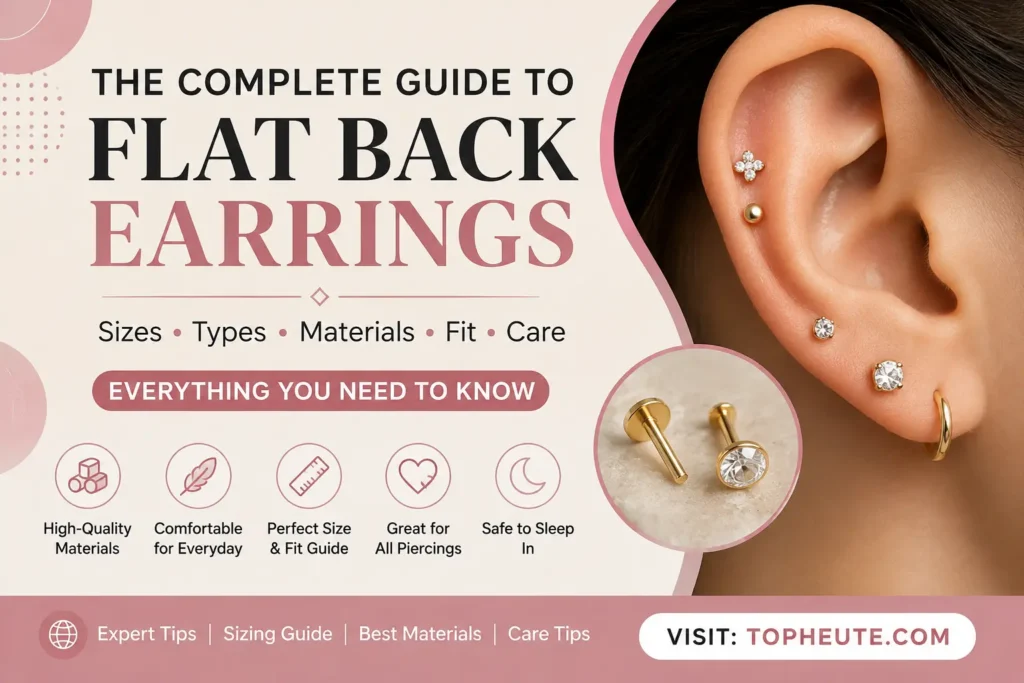
Flat back earrings are low-profile stud-style jewelry designed with a smooth disc or flat base behind the ear rather than the familiar butterfly clutch. The design is popular because the rear of the jewelry sits close to the skin, reducing the amount of hardware that can press against a pillow, catch on hair, or interfere with headphones.
The important point is that comfort does not come from the shape alone. Material, gauge, post length, finish, closure system, piercing placement, and your individual anatomy all matter. A well-fitted piece can be comfortable for long periods, while an incorrectly sized piece can feel tight, move too much, or irritate the piercing.
This guide explains the design from the ground up, including how labret-style jewelry works, how to understand gauge and post length, which materials make sense for sensitive or healing ears, how different ear placements affect sizing, and how to troubleshoot common fit problems.
What Are Flat Back Earrings?
A flat back earring is a stud-style piece with a decorative front and a flat disc at the rear. In piercing terminology, this construction is closely related to a labret post. Instead of a protruding clutch, the back is designed to sit relatively flush with the ear.
That simple change can make a noticeable difference in everyday use. A conventional butterfly back can create a pressure point behind the lobe, while a flat disc distributes contact over a broader, low-profile area. The result is particularly useful for people who sleep on their side, wear headphones, or have several piercings close together.
They are not limited to one type of ear piercing. Similar low-profile posts are commonly used for lobes and cartilage placements such as the helix, tragus, conch, and forward helix, provided the jewelry is correctly sized for the anatomy.
How Do Flat Back Earrings Work?
The basic construction has a straight post, a decorative top, and a rear disc. The post passes through the piercing channel, while the top and disc keep the jewelry positioned in place.
The top can attach in different ways. In a threadless system, a small pin on the decorative top is pressed into a hollow post and held by tension. In an internally threaded system, the top screws into internal threads inside the post. Both designs keep the exterior of the post relatively smooth.
Why does the attachment system matter? Because jewelry is not just an ornament; the portion passing through a piercing needs a suitable finish and construction. Smooth, well-made jewelry is less likely to scrape the channel during insertion or removal.
Parts of a Flat Back Earring
The decorative top is the visible part and can be a plain disc, gemstone, bead, opal, cluster, or another design. The post is the straight section that passes through the piercing. Its thickness is described by gauge, while its usable length is measured in millimeters.
The rear disc is the low-profile base. It provides the “flat back” effect and can be made in different diameters. The attachment mechanism connects the top to the post and may be threadless or internally threaded.
Understanding these parts makes shopping much easier. Instead of choosing jewelry only by appearance, you can evaluate the metal, gauge, post length, top size, and closure separately.
Flat Back Earrings vs Butterfly Back Earrings
The main difference is the rear closure. A butterfly back uses a separate clutch that grips the post and usually protrudes behind the ear. A flat-back design uses an integrated low-profile disc.
For sleeping and daily wear, the lower profile can be more comfortable because there is less hardware sticking out behind the ear. It can also reduce snagging on hair and bedding. This does not mean every flat back is automatically better: a poorly fitted post or unsuitable metal can still cause problems.
Butterfly backs remain practical for traditional fashion studs and quick changes, especially in healed lobe piercings. The better choice depends on the piercing, intended wear, jewelry quality, and personal comfort.
Types of Flat Back Earrings
The main types are distinguished by their attachment mechanism and the material used. Threadless designs use a press-fit connection, while internally threaded designs use a screw connection.
You can also classify them by the decorative top: minimalist discs, gemstone studs, bezel-set stones, opal tops, clusters, and other decorative shapes. For everyday comfort, the top should be proportional to the piercing and should not create unnecessary weight or leverage.
For a healing piercing, construction and material are more important than decorative complexity. For a fully healed piercing, you have considerably more freedom to prioritize style.
Threadless Flat Back Earrings
Threadless jewelry uses a small pin attached to the decorative top. The pin enters a hollow post and stays in place through controlled tension. To remove it, the top is generally pulled apart from the post rather than unscrewed.
The main advantage is convenience. Once the correct fit is established, changing compatible tops can be relatively simple. The top and post must still match in gauge and system.
If a threadless top feels loose, do not repeatedly force it into the piercing. The connection may need adjustment or replacement. A professional piercer can check the fit rather than guessing.
Internally Threaded Flat Back Earrings
Internally threaded jewelry has threads inside the post. The decorative top screws into those internal threads, leaving the outside of the post smooth.
This system can provide a secure connection, but changing a tiny threaded top can be harder in a tight location such as a tragus. Always hold the appropriate components rather than twisting the jewelry through the piercing itself.
Internally threaded does not automatically mean high quality. The metal, finish, dimensions, manufacturing quality, and fit still determine whether a piece is appropriate.
Flat Back Earring Size Guide
There are three measurements worth understanding before buying: gauge, post length, and decorative top size.
Gauge describes the thickness of the post. Post length describes the usable bar length. Top size describes the visible decorative component.
A common mistake is to assume that one measurement works for every ear. Piercing placement and anatomy can change the required length significantly. Swelling also changes the amount of room needed during early healing.
For this reason, published size charts are starting points, not guarantees. If you do not know your existing gauge or post length, measuring a current well-fitting piece or asking a professional piercer is safer than guessing.
Flat Back Earring Gauge Explained
Gauge is a reverse thickness scale: a higher gauge number generally means a thinner post. Common ear-jewelry sizes include 20G (about 0.8 mm), 18G (about 1.0 mm), and 16G (about 1.2 mm).
Many lobe piercings use thinner jewelry than cartilage piercings, but there is no universal rule. Your established piercing channel determines what fits safely.
Do not force a thicker post through a smaller channel simply because the listing says it is a popular size. Likewise, repeatedly wearing a substantially thinner piece can change how a piercing behaves. When the gauge is uncertain, professional measurement is the sensible option.
Flat Back Earring Post Length Explained
Post length is the distance available for the tissue between the decorative front and the rear disc. It needs to accommodate the thickness of your ear without excessive pressure.
A post that is too short can press the disc or top into tissue. A post that is excessively long can move more than necessary, catch on objects, and become annoying during sleep.
Healing piercings often need additional room for swelling, while healed piercings may be fitted more closely. There is no single “perfect” length for everyone. A piercer can select the length based on the actual anatomy rather than a generic chart.
How to Choose the Right Size Flat Back Earrings
Start with the piercing location, then determine the correct gauge and post length. Next consider the decorative top diameter and weight.
For a healed lobe, a shorter post may work when the tissue is thin and stable. A cartilage piercing can require a different length because cartilage thickness and placement vary. A fresh piercing may need additional space for expected swelling.
Ask yourself three questions: Does the post match the established gauge? Is there enough room without constant pressure? Is there so much extra length that the jewelry moves and catches? If the answer to any of these is uncertain, have the jewelry fitted professionally.
Which Piercings Can Wear Flat Back Earrings?
Low-profile labret-style jewelry is commonly used for many ear placements, including lobes, helix, forward helix, flat, tragus, and conch piercings. The exact jewelry depends on anatomy and the angle of the piercing.
The shape is especially useful where a protruding back would collide with a pillow, headphones, or the opposite side of the ear. Some placements have limited space, so top size and post length become particularly important.
Not every piercing should use the same style. A professional piercer can determine whether a straight post is appropriate for a specific anatomy.
Explore more amazing, latest, and insightful articles Visit Respiratory Therapist.
Flat Back Earrings for Lobe Piercings
Lobes generally offer the easiest fit because they contain softer tissue and usually have more room for jewelry. Low-profile studs are popular for first, second, and stacked lobe placements.
For healed lobes, comfort is usually improved by choosing a post that is not excessively long and a top that is not unnecessarily heavy. If you have multiple lobe piercings, keeping tops proportional can prevent neighboring pieces from rubbing together.
For a new lobe piercing, jewelry selection should prioritize biocompatible material, smooth construction, and adequate room for swelling rather than fashion alone.
Flat Back Earrings for Cartilage Piercings
Cartilage piercings generally require more careful fitting because cartilage is less forgiving of pressure and can take much longer to settle than a lobe.
Low-profile labret-style jewelry is frequently chosen for cartilage because the rear disc is less likely to press into a pillow or catch on clothing. Placement-specific sizing still matters: a helix, tragus, and conch do not have identical anatomy.
Headphones, helmets, hats, hair, and sleeping pressure can all affect a healing cartilage piercing. If irritation persists, changing jewelry repeatedly without identifying the cause can make the situation worse.
Flat Back Earrings for Helix Piercings
A helix piercing sits along the upper outer rim of the ear. Because this area often contacts pillows and hair, a low-profile rear disc can be useful for reducing snagging.
The required post length depends on the thickness of the rim and the amount of swelling. A decorative top that is too large can also catch on hair or headphones.
During healing, avoid repeatedly rotating or playing with the jewelry. The goal is stable, appropriately sized jewelry with minimal unnecessary movement.
Flat Back Earrings for Tragus Piercings
The tragus is the small cartilage flap in front of the ear canal. Its compact anatomy makes low-profile jewelry particularly practical.
Because the area is close to the ear canal, headphones and earbuds can create pressure. The rear disc also needs to fit without pressing into surrounding tissue.
Tragus sizing is especially difficult to guess from a generic chart. A professional piercer can evaluate the thickness and angle of the piercing and select an appropriate post length.
Flat Back Earrings for Conch Piercings
A conch piercing passes through the broad cartilage area of the inner ear. A flat-backed stud can provide a clean appearance while keeping the rear hardware close to the ear.
Conch anatomy varies substantially, so one person’s post length may not work for another. A larger decorative top may look attractive, but excessive size or weight can create leverage on the piercing.
Choose the post first based on fit and placement, then select a decorative top that is proportionate to the available space.
Flat Back Earrings for Sensitive Ears
Sensitive ears need attention to both jewelry material and physical fit. A low-profile backing can reduce pressure and snagging, but it cannot compensate for a metal that your skin does not tolerate.
Look for a clearly specified material rather than relying only on words such as “hypoallergenic.” For new or irritated piercings, implant-grade titanium with appropriate certification is a commonly preferred option. Certain solid gold alloys may also be suitable when properly made for body jewelry.
If you develop persistent redness, swelling, significant pain, discharge, or other concerning symptoms, do not assume the problem is simply an earring allergy. Seek appropriate medical or professional piercing advice.
Best Materials for Flat Back Earrings
Material selection should be based on the piercing’s condition and your skin’s tolerance. Implant-grade titanium is widely used for initial and long-term body jewelry because it is lightweight and can be manufactured to appropriate biocompatibility standards.
Suitable solid gold can also be used when the alloy, purity, finish, and construction are appropriate. Niobium is another biocompatible option.
The label matters. “Hypoallergenic,” “surgical steel,” or “nickel-free” should not be treated as sufficient proof of quality without knowing the actual material and, for body jewelry, the relevant standard or documentation.
Titanium vs Gold vs Sterling Silver Flat Back Earrings
Implant-grade titanium is a strong choice when low weight, biocompatibility, and healing compatibility are priorities. Solid 14K or 18K gold can be an excellent premium option when it is specifically suitable for body jewelry and free from problematic alloying elements.
Sterling silver is popular for conventional fashion jewelry, but it is not generally the first choice for a fresh or healing piercing. It can tarnish and is not considered an ideal material for a healing piercing channel.
For healed ears, the decision can be based more heavily on appearance, budget, and personal tolerance. For healing tissue, material standards and professional fitting should take priority over price or trend.
Flat Back Earrings for New vs Healed Piercings
New and healing piercings need a different approach from fully healed piercings. During healing, swelling and changing tissue conditions make adequate space, smooth construction, and appropriate material especially important.
A professional piercer normally selects initial jewelry based on anatomy and expected swelling, then may downsize the post when the swelling has settled. “Downsizing” means replacing an unnecessarily long initial post with a shorter one once the tissue no longer needs that extra room.
Do not treat the first comfortable-looking week as proof that healing is complete. Cartilage can remain vulnerable for months even when the outside looks normal.
Are Flat Back Earrings Comfortable for Sleeping?
They can be more comfortable for sleeping because the rear disc has a low profile instead of a protruding clutch. This can reduce pressure points, particularly for side sleepers.
Comfort still depends on fit. A post that is too long can move around, while one that is too short can create pressure. Large or heavy decorative tops can also become uncomfortable even when the rear is flat.
If a healing piercing hurts when you sleep on it, the safest solution is not simply to tighten the jewelry. Reducing pressure and having the fit assessed is more useful.
How to Put In Flat Back Earrings
For a fully healed piercing, wash your hands before handling jewelry. Clean the jewelry according to the manufacturer’s instructions and make sure the piercing is not irritated.
With a threadless system, the decorative top is aligned with the post and pressed into place. With an internally threaded system, the top is carefully aligned and screwed into the post without forcing or cross-threading it.
Never push jewelry through resistance. If the channel feels tight, painful, swollen, or partially closed, stop rather than using force. A professional piercer can insert or replace the jewelry safely.
How to Remove Flat Back Earrings
The removal method depends on the closure. Threadless tops are separated from the post with a controlled pull, while internally threaded tops are unscrewed from the post.
Hold the jewelry securely and avoid twisting the post through the piercing. If the top will not move, repeated force can injure the tissue or damage the jewelry.
For a difficult location such as a tragus, professional removal can be much easier because visibility and grip are limited.
How to Clean and Care for Flat Back Earrings
Clean hands are the first step before touching jewelry or a piercing. For healing piercings, follow the aftercare instructions provided by your professional piercer and avoid harsh chemicals or aggressive scrubbing.
Do not repeatedly rotate the jewelry simply to “keep the hole open.” Excessive movement can irritate healing tissue.
For removable jewelry in healed piercings, clean the piece according to its material and manufacturer’s instructions. Different gemstones and metals have different cleaning tolerances, so avoid assuming that every piece can be soaked in the same solution.
How to Know if Your Flat Back Earrings Fit Correctly
A correctly fitted piece should sit comfortably without persistent pressure, severe movement, or obvious embedding. The rear disc should not be digging into the tissue, and the decorative top should not constantly press into the front.
A little movement does not necessarily mean the post is wrong, but excessive movement is a reason to reassess the length. If the jewelry leaves a deep indentation, feels increasingly tight, or becomes difficult to clean around, it may be too short.
For healing piercings, changes in swelling can alter the fit. A professional check is preferable to repeatedly changing jewelry yourself.
Common Flat Back Earring Problems and Solutions
If the jewelry feels too tight, the post may be too short or swelling may have increased. Do not compensate by forcing or twisting it; have the fit assessed.
If it moves excessively, the post may be longer than necessary. Excess movement can increase snagging and irritation.
If the skin reacts, investigate the material and the fit rather than assuming the decorative design is the problem. If the closure keeps loosening, the attachment mechanism may need adjustment or replacement.
If a piercing becomes increasingly painful, hot, very swollen, or produces concerning discharge, treat that as a health issue rather than a simple jewelry problem and seek professional medical advice.
How to Choose the Best Flat Back Earrings
Start with the piercing rather than the decoration. Identify whether it is healed or still healing, determine the correct gauge and post length, then choose a suitable material.
Next consider the closure. Threadless systems can be convenient for top changes, while internally threaded systems offer a secure screw connection. Finally, choose a decorative top that is light enough and appropriately sized for the placement.
For sensitive or healing ears, transparent material specifications and reputable manufacturing are more valuable than vague claims such as “premium” or “hypoallergenic.”
Flat Back Earrings Buying Guide
Use this checklist before purchasing:
• Confirm the piercing location and whether it is healed.
• Verify the gauge rather than guessing.
• Check the available post length in millimeters.
• Choose a material with a clearly stated composition and appropriate standard for the intended use.
• For healing piercings, prioritize implant-compatible jewelry and professional fitting.
• Check whether the closure is threadless or internally threaded.
• Consider the size and weight of the decorative top.
• Avoid jewelry that leaves no room for normal tissue or swelling.
• Avoid excessively long posts that constantly catch on hair and bedding.
• Buy from a source that can provide meaningful material and sizing information.
The best piece is not necessarily the most expensive or most fashionable. It is the one whose material, dimensions, construction, and placement are appropriate for your ear.
FAQs
Q: Are flat-back studs better for sensitive ears?
A: The low-profile design can reduce mechanical irritation, but sensitivity is strongly affected by the metal. Choose a clearly identified, suitable material and make sure the jewelry fits correctly.
Q: What gauge is common for ear piercings?
A: Common sizes include 20G, 18G, and 16G, but the correct gauge depends on the existing piercing. Do not force a different thickness into a piercing.
Q: Is 6 mm always the right post length?
A: No. Post length depends on anatomy, placement, and whether the piercing is healing or healed. A professional fitting is more reliable than choosing a universal length.
Q: Can I sleep in flat-back studs?
A: Many people find low-profile backs more comfortable for sleeping than protruding closures. Comfort still depends on correct sizing and the condition of the piercing.
Q: Are titanium posts good for sensitive ears?
A: Appropriately manufactured implant-grade titanium is widely used for body jewelry and is a common choice when metal sensitivity is a concern.
Q: Can these studs be used in cartilage?
A: Low-profile labret-style jewelry is commonly used in helix, tragus, conch, forward helix, and other suitable cartilage placements, but the jewelry must be sized for the specific anatomy.
Q: What is the difference between threadless and internally threaded jewelry?
A: Threadless jewelry uses a press-fit pin, while internally threaded jewelry uses a screw that connects to threads inside the post.
Q: Why does my earring feel too tight?
A: The post may be too short, or swelling may have changed the fit. Do not force or tighten it; have a professional assess the jewelry and tissue.
Q: Can I change jewelry in a new piercing myself?
A: It is generally safer to have a professional piercer handle jewelry changes while a piercing is healing, especially when swelling, pain, or resistance is present.
Q: Does “hypoallergenic” guarantee a safe earring?
A: No. The term alone does not identify the material or manufacturing standard. Look for a specific, verifiable material description.
Conclusion
Flat-back jewelry is popular for a simple reason: its low-profile construction can make everyday wear more comfortable and practical. But the real advantage comes from the complete setup, not the backing alone.
The right choice combines suitable material, correct gauge, appropriate post length, compatible closure, and a design that matches the piercing’s anatomy. Lobes, helix, tragus, and conch placements can all have different requirements.
If you are buying for a healing piercing, prioritize professional fitting and appropriate body-jewelry materials. If the piercing is fully healed, you have more flexibility to choose based on comfort, style, and budget. The safest approach is to treat jewelry selection as a fit-and-material decision first and a fashion decision second.
Explore more amazing, latest, and insightful articles Visit LVNV Funding LLC.