Seeing a new collection account on a credit report can be confusing, especially when the name is different from the company originally associated with the account. You may also receive a letter from one company while the account is described as being owned by another. The first step is to slow down, identify who owns the account, determine whether the debt is yours, and understand what rights and deadlines apply.
The company discussed in this guide is a debt buyer that may own consumer accounts after they have been charged off by an original creditor. Its portfolio can be serviced by Resurgent Capital Services or referred to other collection agencies. That distinction matters because the owner, servicer, original creditor, and agency contacting you are not necessarily the same entity.
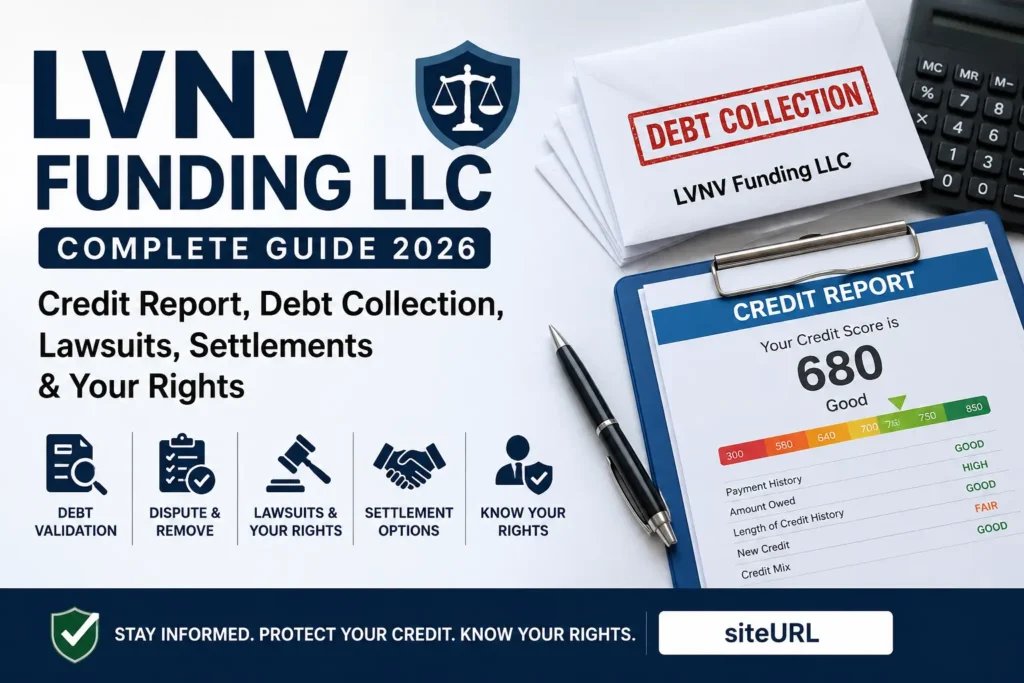
This guide explains the process from beginning to end: why a collection appears, how to read a validation notice, how to dispute an inaccurate account, how credit reporting works, what to know about lawsuits and time-barred debt, and what to consider before paying or settling.
LVNV Funding LLC: What Is It and How Does It Work?
LVNV Funding LLC is a debt-buying company. A debt buyer purchases certain portfolios of unpaid consumer accounts from creditors or other account owners. The original creditor may have already charged off an account after repeated nonpayment. A charge-off is an accounting and credit-management event; it does not automatically erase the underlying obligation.
The company’s own consumer information describes a typical sequence: a consumer uses a credit card, loan, store account, or other service; payments become delinquent; the original account may be charged off; and the account may later be sold. After a sale, collection activity can be handled by a separate servicing company or collection agency.
That means the name on your credit report can change without meaning that a brand-new debt was created. The important dates and records are the original account history, the date of first delinquency, the date of any sale or transfer, the current balance, and the information being reported to the credit bureaus.
A simple way to understand the chain is:
Original creditor: the company that first extended credit or provided the service.
Charge-off: the original creditor stops treating the account as a normal performing receivable.
Debt buyer: a company purchases the account or portfolio.
Servicer: a company may manage the account and consumer communications for the owner.
Collection agency or law firm: another party may be assigned or engaged to collect.
Credit bureaus: consumer reporting agencies may receive account information when the furnisher reports it.
Is LVNV Funding LLC Legitimate?
Yes, it is an established debt-buying business. However, the legitimacy of the company and the validity of a particular account are two different questions.
If you see an unfamiliar collection account, do not assume either that the debt is automatically valid or that the company is automatically a scam. A legitimate debt buyer can own an account while the particular information associated with that account can still be disputed because of identity theft, wrong balances, duplicate reporting, incorrect dates, mistaken identity, or other errors.
The safest approach is evidence-first. Check the collection notice, your credit reports, the original creditor, the account number or partial account number, the balance, and the relevant dates. If something does not match your records, use the dispute process rather than relying on a phone conversation alone.
Consumer reviews and complaints can help you understand common concerns, but they do not prove whether your individual account is valid. As of 2026, public complaint records continue to show recurring consumer concerns involving verification, credit reporting, communications, and payment handling. Those reports are useful context, not a substitute for account-level evidence.
Why Is LVNV Funding LLC on My Credit Report?
A collection account may appear after an unpaid consumer account has been charged off and sold or transferred for collection. Your credit report can show the collection company or current account owner separately from the original creditor.
If you do not recognize the name, look for the original creditor field, original balance, current balance, account status, date information, and any remarks. The name alone is not enough to determine what the account represents.
Why can the original creditor and a collection account both appear? A credit report can retain the history of the original account while also displaying a collection account. The original account may show as closed, charged off, or transferred, while the collection account reflects subsequent collection activity.
How long can a collection remain? Negative collection information generally can remain for up to seven years from the original delinquency that led to the collection, subject to the federal reporting rules and the details of the account. Selling or transferring the debt does not normally restart that seven-year reporting period.
Do not confuse the credit-reporting period with the statute of limitations for a lawsuit. They are different clocks. One concerns how long negative information may be reported; the other concerns how long a creditor or collector may have to sue under applicable law.
LVNV Funding LLC and Resurgent Capital Services
Resurgent Capital Services is closely associated with the servicing of accounts owned by LVNV. In practical terms, you may see the owner’s name in your credit file while receiving a letter, email, or phone call from Resurgent or another collection agency.
This explains why a consumer might ask, “Why is Resurgent contacting me when the credit report shows another company?” The answer can be that the account owner has outsourced servicing or collection activity.
A 2026 federal case, Branch v. LVNV Funding LLC, describes an account that had been purchased by LVNV and collection activity outsourced to Resurgent, followed by a referral to another collection company. That case illustrates why several names can appear in the same collection chain without necessarily representing the same legal entity.
Before responding, identify three things: who owns the account, who is currently collecting it, and who the original creditor was. Keep the documents showing those relationships.
How Does LVNV Funding LLC Collect Debt?
Collection activity can involve letters, electronic communications, telephone calls, online account systems, payment arrangements, settlement offers, or referral to another collection agency or law firm. The exact process varies by account and jurisdiction.
A collection notice should give you enough information to understand what is being claimed and how to dispute it. Under the federal debt-collection rules, a validation notice generally identifies the creditor, account information, the current amount, an itemization of changes such as interest, fees, payments, and credits where applicable, and instructions for disputing the debt or requesting original-creditor information.
Collection activity is not the same as a lawsuit. A collection letter does not mean a judgment has been entered. A lawsuit is a court proceeding and creates separate deadlines that must be taken seriously.
If you receive a letter saying an account has moved to a more serious collection stage, do not treat that wording as proof that a lawsuit has already been filed. Check your local court records or the documents actually served on you.
How to Validate an LVNV Funding LLC Debt
Debt validation is the process of checking whether the claimed account belongs to you and whether the information supplied by the collector is sufficient under the applicable rules. It is especially important when you do not recognize the account, the balance seems wrong, or the account details do not match your records.
Start with the validation notice. Look for:
The name and contact information of the collector.
The name of the creditor associated with the debt.
The account identifier, if one is provided.
The current amount claimed.
An itemization showing how the amount was calculated when required.
The deadline for disputing the debt.
Instructions for disputing the debt or requesting information about the original creditor.
If you dispute the debt in writing within the federal validation period, federal rules generally require the collector to pause collection of the disputed amount until the required response is provided. The CFPB explains that consumers generally have 30 days from the validation notice to submit a written dispute under the federal debt-collection rule.
What should you keep? Keep the complete letter, envelope if it has useful mailing information, screenshots of electronic notices, copies of your dispute, proof of delivery, credit reports, account statements, payment records, and every response.
Validation does not necessarily mean the collector must produce every document you imagine, such as an original wet-ink contract, in every circumstance. The specific legal requirements depend on the applicable law and facts. Focus on whether the debt is yours, the amount is accurate, the creditor can be identified, and the information supplied is sufficient under the governing rules.
How to Dispute an LVNV Funding LLC Account on Your Credit Report
If the credit report contains inaccurate or incomplete information, you can dispute the information with the relevant credit reporting agency and, where appropriate, with the company furnishing the information.
First, identify the exact error. Examples include a debt that is not yours, an incorrect balance, duplicate collection accounts, wrong account status, inaccurate dates, payments that are missing, or information belonging to another person.
Second, gather evidence. A useful dispute is specific rather than emotional. Explain exactly what is wrong and attach copies of documents that support your position.
Third, submit the dispute through an appropriate channel and keep proof of submission. If you dispute through a credit bureau, retain the confirmation and the result. If you send a written dispute to a collector, retain a copy and proof of delivery.
Fourth, review the result. If the information is corrected, compare the updated credit reports with your records. If the information remains inaccurate, document what was disputed, what response you received, and what evidence was considered.
The CFPB currently advises consumers to dispute inaccurate or incomplete credit-report information with the credit reporting agency first before submitting a complaint through its consumer complaint system. That sequence is important when you are deciding what to do after a failed credit-report dispute.
How to Remove LVNV Funding LLC From Your Credit Report
There is no legitimate universal trick that guarantees deletion of an accurate collection account. Removal generally depends on why the account is being reported and what happens after a dispute, correction, settlement, payment, or the expiration of the applicable reporting period.
If the account is inaccurate, dispute the specific inaccurate information. If the account results from identity theft, use the identity-theft dispute process and provide the documentation requested by the relevant parties. If the account is accurate, it may remain for the legally permitted reporting period even if you pay it.
Can paying a collection automatically delete it? No. Payment can change the status, but an accurate collection does not automatically have to disappear simply because the balance reaches zero.
Can a collector voluntarily delete an accurate account after payment or settlement? Policies vary, and you should not assume deletion will occur unless you have a written agreement that clearly addresses what will be reported.
The key distinction is between correction and deletion. If information is wrong, the goal is accurate reporting. If information is accurate and still within the reporting period, the law generally does not require deletion merely because you disagree with the entry.
Can LVNV Funding LLC Sue You?
A debt buyer may pursue collection through litigation when permitted by applicable law. Whether a lawsuit can be filed, whether it is timely, and what remedies are available depend on the debt, the contract, the state, the procedural history, and the dates involved.
A collection letter is not a lawsuit. A summons or complaint is different and should never be ignored.
If you receive court papers, read the caption, case number, court, response deadline, hearing date, and amount claimed. Missing a deadline can lead to a default judgment even when you have defenses or disputes.
Can a judgment lead to wage garnishment or other collection remedies? Potentially, but the answer depends on state law, federal protections, exemptions, the type of debt, and the court process. A collector does not automatically gain the right to garnish wages merely because it sent you a collection letter.
If you are sued, consider speaking with a consumer-law or debt-defense attorney or a qualified legal-aid organization in your state. The strongest response depends on the documents and local law.
LVNV Funding LLC Lawsuits and Legal Cases
Legal cases involving debt buyers can involve several different issues, including alleged collection practices, credit reporting, communications, settlement conduct, standing, evidence of ownership, and procedural questions. A case involving the company should not be treated as proof that every consumer account has the same problem.
There are current 2026 examples. In Light v. LVNV Funding LLC, the Eleventh Circuit addressed standing in an FDCPA action arising from a debt-collection dispute and dismissed the appeal for lack of Article III standing. In McFarland v. LVNV Funding LLC, a Western District of Pennsylvania court considered cross-motions for summary judgment in an FDCPA case and denied both motions in its June 2026 memorandum opinion.
Another 2026 Florida case, Branch v. LVNV Funding LLC, involved allegations about collection communications and the involvement of Resurgent and another collection agency. The court’s ruling illustrates the importance of examining the exact facts instead of treating every complaint or lawsuit as evidence of wrongdoing.
If you are researching a case that names you, use the case number and court listed on the actual documents. A similar case involving another consumer does not automatically create a defense or legal claim for you.
Explore more amazing, latest, and insightful articles Visit Eevee Evolutions.
LVNV Funding LLC Statute of Limitations
The statute of limitations is the period during which a creditor or collector may have the legal right to sue to collect a debt. It is not the same as the period that negative information can appear on a credit report.
How long is the limitation period? There is no single nationwide number for every consumer debt. It can depend on the type of debt, the state law that applies, the contract, and sometimes where the consumer lives or where the claim is brought.
Time-barred debt is debt for which the applicable lawsuit limitation period has expired. That does not necessarily mean the debt disappears. Federal and state rules can still govern whether and how a collector may communicate about it.
Be especially careful before making a payment or acknowledging an old debt. The FTC explains that in some states, a partial payment or written acknowledgment can revive a debt or restart the limitation period. Because the rules differ, check the law applicable to your situation before taking action on an old account.
Also remember that the FDCPA itself has a separate one-year limitation period for bringing many FDCPA claims. That deadline is different from the state-law deadline for suing over the underlying debt.
LVNV Funding LLC Settlement and Payment Options
If the debt is valid and you decide to resolve it, you may encounter options such as paying the balance in full, using a payment plan, or negotiating a settlement for less than the claimed balance. Which option is best depends on your finances, the age and status of the debt, the reporting consequences, and your legal position.
Before agreeing to a settlement, ask for the terms in writing. The agreement should make clear the amount to be paid, the payment dates, what happens after the final payment, and whether the payment resolves the entire account.
Do not rely on a verbal promise that a debt is “settled” if the written terms say something different.
If you are dealing with an old debt, check the statute of limitations before making a payment. A settlement can be financially sensible in one situation and risky in another, especially when limitation rules could be affected by a payment or acknowledgment.
If you cannot afford the proposed amount, do not promise a payment you cannot make. A missed payment under a new arrangement can create another collection problem.
What Happens If You Pay LVNV Funding LLC?
Payment can change an account’s balance and status, but it does not automatically erase the credit history. A collection account may continue to appear for the remainder of the applicable reporting period, although its status can be updated to show that the balance was paid.
How quickly will the credit report update? Timing varies by furnisher and reporting cycle. A credit bureau may not show the change immediately after a payment. Keep your receipt and confirmation until the account is correctly reflected.
If you settle for less than the full amount, make sure the written agreement says what the settlement accomplishes. Keep the settlement letter, payment confirmations, and final account documentation.
If taxes could be affected by cancellation of debt, consider asking a qualified tax professional about your circumstances. Debt settlement can have tax consequences in some situations.
LVNV Funding LLC and the FDCPA
The Fair Debt Collection Practices Act, or FDCPA, is a federal law that restricts certain abusive, unfair, and deceptive debt-collection practices. It covers many consumer debts, including credit-card debt, medical debt, personal loans, and other household obligations.
The FDCPA addresses areas such as harassment, deceptive representations, unfair collection methods, communications, and certain practices involving time-barred debt. Regulation F provides detailed federal rules implementing parts of the debt-collection framework.
A key point is that not every dispute with a debt collector is automatically an FDCPA violation. The facts matter: what was said, when it was said, who received it, whether the person was a consumer, what type of debt was involved, what law applies, and what evidence exists.
If you believe your rights were violated, preserve the communication rather than deleting it. Save letters, emails, voicemails, call logs, payment records, and court documents.
LVNV Funding LLC and the FCRA
The Fair Credit Reporting Act, or FCRA, governs many aspects of consumer reporting and requires accuracy in circumstances covered by the law. When a collection account is reported, errors can involve identity, balance, account status, dates, ownership, or duplicate reporting.
A credit-report dispute should identify the specific information that is inaccurate or incomplete. Saying only “this is not fair” is less useful than stating, for example, that the balance does not match the available account records or that the account belongs to someone else.
The FCRA and the FDCPA are different laws. The FDCPA primarily regulates certain debt-collection conduct, while the FCRA addresses consumer reporting and related responsibilities. One dispute may involve issues under both laws, but the elements and procedures are not identical.
Because credit-reporting law can be fact-specific, avoid relying on generic internet templates that promise automatic deletion or a guaranteed legal result.
LVNV Funding LLC Contact Information
The safest contact information is the information printed on the current collection notice or official account correspondence you received. Collection accounts can be handled by different servicing or collection entities, so using an old number or an unrelated website can create unnecessary risk.
Before sharing bank-account numbers, Social Security numbers, passwords, or other sensitive information, verify that you are communicating with the correct company. The CFPB advises consumers not to provide sensitive financial information until they have verified the debt collector and the debt.
If you are unsure whether a message is genuine, do not click an unexpected payment link or rely solely on caller ID. Compare the communication with your credit report and prior account documents, and independently verify the company through a trusted source.
What Should You Do If LVNV Funding LLC Contacts You?
Your first move should be organization, not panic.
Save the entire collection letter, email, or message.
Check your credit reports and identify the original creditor, balance, account dates, and account status.
Determine whether you recognize the account.
Check the validation information and the dispute deadline.
If you dispute the debt, submit a clear written dispute within the applicable deadline and keep proof.
If the information on your credit report is inaccurate, dispute the specific error with the appropriate credit reporting agency and preserve the result.
If the debt is old, determine the applicable statute of limitations before making a payment or acknowledgment.
If you receive a lawsuit, calendar the response deadline immediately and seek qualified local legal help if needed.
If you decide to pay or settle, get the agreement in writing before sending money.
What if you do not recognize the account at all? Treat that as an identity and verification issue. Do not confirm that the debt is yours merely because a caller provides a name or amount. Ask for the required validation information and compare it with your own records.
What if you suspect identity theft? Follow the applicable identity-theft dispute process and preserve evidence such as an identity-theft report, account records, and correspondence. Identity theft can require action with both the credit reporting agencies and the companies furnishing the information.
LVNV Funding LLC by State
State law matters. Debt-collection rules, lawsuit limitation periods, wage exemptions, service requirements, court procedures, and protections for certain income or property can vary significantly between states.
For example, the answer to “Can an old collection account still be sued on?” cannot safely be answered from a generic national rule. You need the type of debt, the relevant dates, the applicable state law, and any rules governing revival or tolling.
Consumers in California, Texas, Florida, New York, Pennsylvania, Illinois, Ohio, Georgia, and other states should therefore verify the law that applies in their own jurisdiction rather than relying on a state-specific number found in an unrelated article.
A useful state-by-state checklist is:
Identify the type of debt.
Find the date of the first missed payment and relevant account history.
Check the applicable statute of limitations.
Check whether the state has rules about revival after payment or acknowledgment.
Review state debt-collection protections.
Check wage, bank-account, property, and benefit exemptions if a lawsuit or judgment is involved.
Use the state court’s own records and filing information when checking for a case.
Frequently Asked Questions About LVNV Funding LLC
Is LVNV Funding LLC a scam?
The company is an established debt buyer. That does not mean every collection account associated with it is automatically correct. Verify the specific debt, balance, dates, and original creditor before deciding what to do.
Why is this company on my credit report?
A collection account can appear after an unpaid account has been charged off and sold or transferred. Check the original creditor and account history to understand where the collection came from.
Who is Resurgent Capital Services?
Resurgent Capital Services is a servicing and collection company associated with accounts owned by LVNV. Depending on the account, another collection agency may also become involved.
What is a debt validation notice?
It is a notice containing information intended to help a consumer identify a claimed debt and understand how to dispute it or request information about the original creditor. Federal rules specify required validation information in covered circumstances.
How long does a collection stay on a credit report?
Negative collection information generally can remain for up to seven years from the original delinquency that led to the collection, subject to the applicable federal reporting rules. That reporting period is separate from the statute of limitations for filing a lawsuit.
Can paying a collection remove it from my credit report?
Not automatically. Payment can update the account status, but an accurate collection may remain for the rest of its permissible reporting period.
Can a debt buyer sue me?
A debt buyer may pursue a lawsuit when permitted by applicable law. Whether a particular claim is timely and legally enforceable depends on the debt, dates, state law, evidence, and procedural history.
What is time-barred debt?
Time-barred debt is generally debt for which the applicable statute of limitations for a lawsuit has expired. The debt itself does not necessarily disappear, and the rules governing collection communications vary by state.
Can making a payment restart the statute of limitations?
In some states, a payment or written acknowledgment can revive a debt or restart the limitation period. Because this varies by jurisdiction, check the applicable law before making a payment on an old debt.
What if the debt is not mine?
Dispute it promptly, preserve evidence, and follow the applicable identity-theft and credit-report dispute procedures. Do not acknowledge responsibility for an account you do not recognize simply to end a phone call.
What if the balance is wrong?
Document the correct amount and dispute the inaccurate information with the appropriate parties. Keep statements, payment records, settlement documents, and copies of the dispute.
What if I receive court papers?
Do not ignore them. Read the response deadline and court information immediately. A court case is different from a collection letter, and missing a deadline can result in a default.
Should I settle a collection account?
There is no universal answer. Consider the debt’s validity, age, statute of limitations, your finances, credit-reporting consequences, and the written terms of the proposed settlement. Get the agreement in writing before paying.
Can I stop collection calls?
Federal and state laws provide protections concerning debt-collection communications. The exact steps and effect of a request to stop communications depend on the circumstances. Keep a record of your request and subsequent contacts.
What is the difference between the debt owner and the collection agency?
The debt owner has the ownership interest in the account. A collection agency may be hired or assigned to collect it. A servicing company can sit between the owner and the agency. These roles can belong to different legal entities.
Does a charge-off mean I no longer owe the debt?
Generally, no. A charge-off is an accounting and credit-management event. The account may later be sold or assigned for collection, subject to applicable law.
Can a collection account be deleted if it is accurate?
Accurate information generally is not required to be deleted merely because a consumer requests deletion. Incorrect information should be disputed and corrected. The account should also age off when the applicable reporting period ends.
How should I protect myself from collection scams?
Verify the debt before sharing sensitive information or sending money. Compare the communication with your records, ask for required validation information, and independently confirm the collector’s identity.
Conclusion
A collection account is easier to handle when you separate the questions instead of treating everything as one problem. First determine whether the debt is yours. Then identify the original creditor, current owner, servicer, and collector. Check the balance and dates. Understand the validation process. If the credit report is inaccurate, dispute the specific error. If the debt is old, check the applicable statute of limitations before making a payment or acknowledgment. If you are sued, respond to the court deadline rather than treating the lawsuit like an ordinary collection letter.
The most important rule is simple: do not make a rushed payment just because a collection notice makes you anxious. Get the facts, preserve your records, understand the applicable deadlines, and make decisions based on verified information.
2026 accuracy note: This article reflects federal consumer-debt and credit-reporting guidance available through August 2026 and incorporates recent 2026 litigation involving the company. State law and account-specific facts can change the legal outcome, so time-sensitive legal questions should be checked against current law in the relevant jurisdiction.
Explore more amazing, latest, and insightful articles Visit Respiratory Therapist.