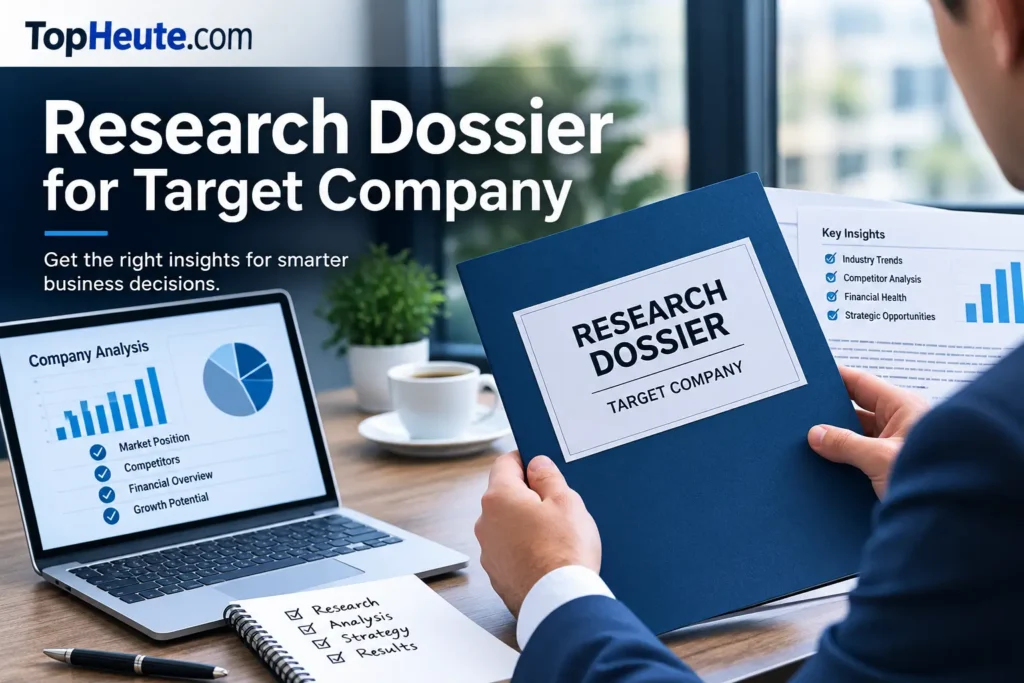
A research dossier for target company is a structured business research document that brings important information about one organization into a single, organized place. A research dossier for target company can help an investor, sales professional, marketer, consultant, journalist, student, business owner, buyer, supplier, or researcher understand how a company operates, makes money, serves customers, competes in its market, and handles potential risks.
Company information is often scattered across official websites, annual reports, regulatory records, news coverage, professional profiles, customer reviews, industry publications, business directories, and other public sources. Looking at these sources separately can make it difficult to understand the complete picture. A well-prepared dossier connects the information, explains what it means, and clearly separates verified facts from estimates, opinions, and assumptions.
The purpose is not to collect every available fact. The purpose is to collect the right facts for a specific research objective.
For example, someone researching a company before a partnership may care about its operations, reputation, customers, and financial stability. A competitor researcher may focus more heavily on products, pricing, market positioning, customer segments, marketing channels, and competitive advantages. An investor may need deeper financial, ownership, legal, and risk information.
The strongest company research therefore starts with a clear question and then builds evidence around that question.
What Is a Research Dossier for Target Company?
A research dossier is a detailed business research report prepared around a specific company. It combines company information, supporting evidence, market context, competitive intelligence, financial information, operational details, and analysis.
The phrase target company simply means the organization being investigated. It does not automatically refer to the American retailer Target. The target could be a startup, private business, public corporation, software company, manufacturer, retailer, service provider, potential customer, supplier, acquisition candidate, employer, or competitor.
A company research dossier normally answers several fundamental questions:
- What does the company do?
- Who owns and manages it?
- What products or services does it provide?
- Who are its customers?
- How does it make money?
- Where does it operate?
- What market does it serve?
- Who competes with it?
- What differentiates it?
- What are its major strengths and weaknesses?
- What risks could affect the business?
- What opportunities could influence future growth?
- Which information is verified and which remains uncertain?
This makes a dossier more useful than a simple company profile.
A company profile might provide a short description of the organization. A research report goes deeper by connecting facts to a defined research purpose and documenting the evidence behind important findings.
Why Is a Research Dossier for Target Company Important?
Business decisions become difficult when they are based on incomplete information.
A company may have an impressive website, strong marketing, attractive products, or positive public messaging, but those elements do not necessarily reveal its complete business position. Research can uncover information about ownership, revenue sources, customer concentration, competitors, legal matters, operational dependencies, market changes, and other factors that may not be obvious from promotional material.
A well-prepared company analysis helps reduce this information gap.
It can be useful when:
- Evaluating a potential investment
- Researching a prospective customer
- Preparing for a sales meeting
- Studying a competitor
- Considering a business partnership
- Evaluating a supplier
- Researching an acquisition target
- Preparing for an interview
- Conducting academic research
- Performing market research
- Assessing an employer
- Investigating an industry
- Planning a marketing strategy
What does good company research actually help you understand?
It helps you move from isolated facts toward relationships between facts.
For example, revenue growth can look positive by itself. However, the meaning changes if that growth depends heavily on one customer, one product, one geographic market, or substantial borrowing. Similarly, a large employee count does not automatically indicate operational strength if the workforce has changed significantly or the business is restructuring.
The value of research comes from context, verification, comparison, and interpretation.
Company Overview and Background
The company overview provides the foundation for the entire report.
Start by identifying the organization accurately. This is particularly important when a brand operates through multiple legal entities, subsidiaries, trading names, or regional businesses.
Useful company information includes:
- Official legal name
- Common trading name
- Industry
- Headquarters
- Main operating locations
- Founding date
- Founders
- Parent company
- Subsidiaries
- Ownership type
- Public or private status
- Main products or services
- Primary customer groups
- Main geographic markets
- Official business purpose
The legal company name and consumer-facing brand name may be different, so they should not automatically be treated as the same entity.
A strong company overview also explains what the organization actually does in plain language.
Instead of simply repeating a corporate description, explain the business model in terms an ordinary reader can understand.
For example, if a company provides enterprise software, explain what problem the software solves, who pays for it, how customers access it, and whether the company earns revenue through subscriptions, licensing, implementation, advertising, or another model.
Company History and Key Milestones
Company history explains how the present organization developed.
Important milestones can include:
- Founding
- Major ownership changes
- Acquisitions
- Mergers
- Product launches
- Major partnerships
- Geographic expansion
- Entry into new industries
- Rebranding
- Leadership changes
- Major funding events
- Public listing
- Restructuring
- Major strategic shifts
History should not become a long chronological biography with no business relevance.
The useful question is:
Which historical events help explain the company as it exists today?
For example, an acquisition may explain why a company now offers a particular service. A change in ownership may explain a new strategic direction. Expansion into another country may explain changes in staffing, revenue, or customer demographics.
Why are milestones important?
Milestones provide context for current performance.
A company that recently entered a new market should not necessarily be compared with a mature competitor as though both have identical market histories. Likewise, a newly launched product should not be evaluated using the same expectations as an established product with years of sales data.
Ownership and Corporate Structure
Ownership research identifies who legally or economically controls the organization.
Depending on the business, this may involve:
- Founders
- Individual shareholders
- Institutional investors
- Parent companies
- Holding companies
- Private equity firms
- Venture capital investors
- Public shareholders
- Family ownership
- Government ownership
- Subsidiaries
- Joint ventures
Corporate structure can become complicated when a company operates through multiple entities.
A useful report should distinguish between the brand, the operating company, the parent organization, and relevant subsidiaries.
Why does ownership matter?
Ownership can influence decision-making, financing, expansion, leadership, risk tolerance, and strategic priorities.
For a private company, complete ownership information may not be publicly available. In that situation, the dossier should clearly identify what is known and what remains unverified rather than filling the gap with assumptions.
Leadership and Key Decision-Makers
Leadership research focuses on people who have significant responsibility for the company’s strategy and operations.
Relevant roles may include:
- Chief executive
- Founder
- President
- Chief financial officer
- Chief operating officer
- Chief technology officer
- Board members
- Managing directors
- Regional executives
- Major business-unit leaders
Do not simply list names.
Explain the relevance of the person’s role and identify major leadership changes when they have a clear connection to company strategy.
A leadership profile can also examine professional background, previous roles, tenure, responsibilities, and publicly documented strategic decisions.
Why is leadership information useful?
Leadership changes can affect company strategy, organizational structure, investment priorities, product development, and market expansion.
However, avoid treating a person’s title alone as evidence of business success or failure. Leadership analysis should remain evidence-based.
Products and Services
Products and services are at the center of most commercial research.
For each important offering, examine:
- What it is
- What problem it solves
- Who uses it
- Main features
- Pricing approach
- Delivery method
- Availability
- Geographic coverage
- Product maturity
- Competitive alternatives
- Differentiating characteristics
A product list by itself is not enough.
The research should explain the relationship between the offering and the customer’s problem.
For example, instead of saying that a company sells project management software, explain whether the software targets small teams, large enterprises, specialized industries, or a particular operational problem.
What should you ask about a product or service?
Ask:
Who needs it, why do they need it, how does it work, what does it cost, and what alternatives are available?
These questions create useful commercial intelligence instead of a simple catalog.
Target Market and Customer Base
A company cannot be properly understood without understanding the people or organizations it serves.
Research:
- Customer demographics
- Business customer types
- Industry segments
- Geographic markets
- Customer size
- Buyer roles
- Purchase motivations
- Customer problems
- Customer expectations
- Recurring versus one-time customers
- Premium versus budget segments
- Customer concentration
For business-to-business organizations, identify the likely decision-makers as well as the end users.
For consumer companies, examine the audience’s needs, purchasing behavior, price sensitivity, and reasons for choosing the product.
What is the difference between a target market and a customer base?
The target market is the group the company intends to serve.
The customer base consists of people or organizations that actually buy or use its offerings.
The two can overlap, but they are not always identical.
This distinction can reveal whether the company’s commercial strategy matches its actual market presence.
Business Model and Revenue Streams
The business model explains how the organization creates value and turns that value into revenue.
Common models include:
- Subscription
- Direct sales
- Licensing
- Advertising
- Marketplace commissions
- Transaction fees
- Freemium
- Membership
- Franchise
- Professional services
- Manufacturing
- Wholesale
- Retail
- Affiliate revenue
- Usage-based pricing
Some companies use several revenue streams simultaneously.
A strong business analysis should identify which streams appear most important and whether the available evidence supports that conclusion.
Why are revenue streams important?
Revenue concentration can affect resilience.
If most income comes from one product, customer, geographic market, or distribution channel, that dependency may become an important business consideration.
Company Operations and Geographic Presence
Operations explain how the company actually delivers its products or services.
Research areas can include:
- Offices
- Stores
- Manufacturing facilities
- Warehouses
- Service areas
- Distribution networks
- Suppliers
- Logistics
- Employees
- Technology infrastructure
- Customer support
- Production capabilities
Geographic presence should also be considered.
A company may have a global website but operate physically in only a few locations. Another business may have a local customer base but serve several nearby regions.
For location-based businesses, local business information is especially important because geographic relevance can influence discovery in Google Search, Maps, and other search experiences.
Why does geographic presence matter?
Location affects:
- Customer acquisition
- Shipping
- Service availability
- Labor
- Regulations
- Competition
- Market demand
- Operating costs
- Expansion opportunities
A good operational profile therefore connects physical presence with the company’s commercial strategy.
Financial Performance and Business Health
Financial research should be handled carefully because numbers can be misunderstood without context.
Relevant information may include:
- Revenue
- Revenue growth
- Gross profit
- Operating profit
- Net income
- Cash flow
- Assets
- Liabilities
- Debt
- Funding
- Cash reserves
- Capital expenditure
- Profit margins
Always record the reporting period.
A financial figure without a date can become misleading because businesses change over time.
What does financial health actually mean?
Financial health is broader than revenue.
A company can generate significant revenue while experiencing weak profitability or cash-flow pressure. Conversely, an organization may temporarily report lower profit because it is investing heavily in expansion.
The analysis should therefore consider multiple financial indicators together.
For public companies, official financial filings are generally more useful than unsourced summaries. For private businesses, available financial information may be limited, and the dossier should make that limitation clear.
Market and Industry Analysis
A company does not operate in isolation.
Industry research should examine:
- Market size
- Market growth
- Customer demand
- Major trends
- Economic conditions
- Regulation
- Technology changes
- Consumer behavior
- Supply conditions
- Barriers to entry
- Industry consolidation
- Emerging business models
Why is industry context important?
Suppose a company’s sales increase rapidly. Without industry context, it is difficult to know whether that reflects exceptional company performance, overall market growth, inflation, or a temporary trend.
Industry analysis gives company-level information a broader frame of reference.
It can also reveal external factors that management cannot directly control.
Competitor Analysis
Competitor analysis identifies businesses competing for similar customers, budgets, searches, distribution channels, or use cases.
Competitors should normally be divided into:
- Direct competitors
- Indirect competitors
- Emerging competitors
- Substitute solutions
A direct competitor may offer almost the same product to the same audience.
An indirect competitor may solve the same customer problem through a different approach.
For example, a traditional software provider could compete directly with another software provider while also facing indirect competition from spreadsheets, agencies, internal teams, or automated tools.
Explore more amazing, latest, and insightful articles Visit deviated septum.
What should you compare between competitors?
Compare:
- Products
- Services
- Pricing
- Target customers
- Geographic reach
- Distribution
- Brand positioning
- Customer experience
- Reputation
- Marketing
- Search visibility
- Technology
- Partnerships
- Differentiators
The objective is not to create an arbitrary ranking. It is to understand how the businesses differ and why customers might choose one over another.
Competitive Advantages and Market Position
Competitive advantage describes something that may help a company compete effectively.
Potential advantages include:
- Strong brand recognition
- Proprietary technology
- Patents
- Distribution reach
- Customer loyalty
- Specialized expertise
- Lower operating costs
- Unique products
- Strong partnerships
- Geographic coverage
- Network effects
- Specialized data
- Established relationships
However, a claimed advantage should be tested.
A company describing itself as “the leading provider” is making a marketing claim. That statement should not automatically be treated as independently verified market leadership.
What makes an advantage durable?
A useful question is:
Can competitors easily copy this advantage?
A temporary promotional campaign may create short-term differentiation, while proprietary technology, long-term contracts, specialized expertise, or strong distribution relationships may be harder to reproduce.
Marketing Strategy and Online Presence
Marketing research examines how the company attracts, educates, converts, and retains customers.
Relevant channels include:
- Company website
- Organic search
- Paid search
- Social media
- Email marketing
- Content marketing
- Video
- Influencer marketing
- Partnerships
- Events
- Public relations
- Referral programs
- Marketplaces
The website should be analyzed beyond its appearance.
Look at:
- Main commercial pages
- Content structure
- Product information
- Customer journey
- Calls to action
- Search visibility
- Local visibility
- Brand searches
- Internal linking
- Helpful resources
- Trust information
- Conversion paths
How does modern search change company research?
Google’s current generative search guidance says traditional SEO remains foundational for AI features such as AI Overviews and AI Mode. Google also explains that these experiences can use related searches across subtopics to build responses, making comprehensive and useful information increasingly important.
This means company research should not focus only on exact-match keywords.
It should also examine the broader topics, questions, entities, services, locations, and evidence associated with the business.
Customer Reviews and Public Reputation
Customer feedback can reveal information that company-controlled pages may not discuss.
Research:
- Review volume
- Review themes
- Recurring praise
- Recurring complaints
- Customer service experiences
- Product problems
- Delivery experiences
- Pricing concerns
- Communication issues
- Resolution patterns
Reviews should be treated as customer evidence, not automatically as objective facts.
One person’s complaint does not prove a systemic problem. However, the same issue appearing repeatedly across independent sources may deserve further investigation.
What can customer reviews reveal?
They can help identify:
- Frequently appreciated features
- Common pain points
- Service expectations
- Product weaknesses
- Customer support quality
- Geographic service issues
- Unmet needs
This information can also reveal opportunities for better products, clearer content, improved customer service, and stronger messaging.
Recent News and Company Developments
A company dossier should have a clear research date because business information changes.
Recent developments may include:
- New products
- Acquisitions
- Partnerships
- Funding
- Leadership changes
- Market expansion
- Facility openings or closures
- Restructuring
- Regulatory developments
- Major contracts
- Strategic announcements
- Financial updates
Always distinguish between an announcement and a completed event.
A company may announce an expansion without having completed it. A planned acquisition may still require regulatory approval. A product announcement may not mean broad commercial availability.
This distinction keeps the research accurate.
Technology and Intellectual Property
Technology can be a central business asset, particularly for software, manufacturing, healthcare, engineering, media, and technology companies.
Research may include:
- Proprietary software
- Patents
- Trademarks
- Trade secrets
- Data assets
- Research and development
- Automation
- Artificial intelligence
- Infrastructure
- Technical partnerships
- Product integrations
Intellectual property research should distinguish between what the company owns, what it licenses, and what it simply uses.
Why does intellectual property matter?
Proprietary technology can create differentiation, protect products, support licensing revenue, or create barriers for competitors.
However, the existence of a patent or trademark does not automatically prove that a company has a commercially successful technology.
The business impact must be considered separately.
Legal and Regulatory Information
Legal research helps identify issues that could materially affect a company.
Depending on the business and jurisdiction, relevant areas may include:
- Lawsuits
- Regulatory actions
- Licenses
- Compliance requirements
- Intellectual property disputes
- Employment matters
- Consumer protection
- Environmental requirements
- Industry-specific regulation
- Data protection
- Contractual obligations
Not every legal filing represents wrongdoing.
A lawsuit may contain allegations that have not been proven. A regulatory investigation may end without enforcement. A complaint may be dismissed.
Therefore, legal information should be reported with accurate status and dates rather than presenting allegations as established facts.
Business Risks and Challenges
Risk analysis asks what could negatively affect the organization.
Potential categories include:
- Financial risk
- Market risk
- Competitive risk
- Operational risk
- Technology risk
- Cybersecurity risk
- Regulatory risk
- Legal risk
- Supply-chain risk
- Customer concentration
- Leadership dependency
- Geographic concentration
- Reputation risk
- Economic risk
How do you identify meaningful business risks?
Look for dependencies.
Ask:
What would happen if this important customer left?
What would happen if this supplier became unavailable?
What would happen if regulations changed?
What would happen if a competitor introduced a cheaper substitute?
What would happen if the company’s primary technology became obsolete?
These questions often reveal risks more clearly than generic SWOT statements.
Growth Opportunities and Future Expansion
Growth opportunities should be based on identifiable evidence rather than optimistic speculation.
Potential areas include:
- New geographic markets
- New customer segments
- Product expansion
- Cross-selling
- Partnerships
- Technology adoption
- Operational efficiency
- New distribution channels
- International expansion
- Underserved market segments
A good analysis should distinguish between an existing opportunity and a possible future scenario.
For example, a company announcing plans to enter a new market is evidence of strategic intent. It is not evidence that the expansion will definitely succeed.
Strengths and Weaknesses of the Target Company
Strengths and weaknesses summarize internal characteristics that may influence performance.
Possible strengths include:
- Strong customer relationships
- Specialized expertise
- Recognized brand
- Efficient operations
- Product differentiation
- Financial resources
- Technology
- Distribution
Possible weaknesses include:
- Limited geographic reach
- Product concentration
- Dependence on key customers
- Weak online presence
- Limited resources
- Operational complexity
- Technology dependence
- High costs
The analysis should explain why something qualifies as a strength or weakness.
A long list without evidence does not create useful business intelligence.
How is a weakness different from a risk?
A weakness is generally an internal limitation.
A risk is a possible event or condition that could negatively affect the company.
For example, limited distribution may be an internal weakness, while a major distributor ending its relationship may represent a business risk.
How to Conduct a Research Dossier for Target Company
Start by defining the purpose of the research.
You need to know whether the report is being prepared for:
- Investment research
- Sales preparation
- Competitive intelligence
- Partnership evaluation
- Supplier assessment
- Acquisition research
- Market research
- Academic work
- Employment research
The purpose determines the depth and type of information required.
Then establish the research scope.
Define:
- Company
- Business unit
- Geographic market
- Research period
- Industry
- Research questions
- Required level of detail
After that, collect information from reliable sources and organize it according to the research framework.
Do not immediately interpret every piece of information you find.
First establish what the evidence says.
Then compare sources.
Then identify patterns.
Then explain what those patterns could mean.
What is the most important rule when researching a company?
Never allow an assumption to silently become a fact.
If revenue is estimated, label it as an estimate.
If ownership is unclear, say that it is unclear.
If two sources provide different employee counts, preserve the dates and definitions rather than selecting whichever number looks better.
This simple practice can dramatically improve research quality.
Reliable Sources for Target Company Research
Different sources are useful for different types of information.
Official company sources
These can provide:
- Product information
- Leadership
- Company history
- Announcements
- Locations
- Investor information
- Corporate policies
Company sources are valuable, but remember that they represent the organization’s own perspective.
Regulatory and government sources
These may provide:
- Corporate records
- Financial filings
- Regulatory decisions
- Licenses
- Legal records
- Public registrations
They are particularly useful when verifying information that could be materially important.
Financial sources
For public companies, financial statements and regulatory filings can provide information about:
- Revenue
- Profit
- Debt
- Assets
- Cash flow
- Segments
- Risk disclosures
Industry sources
Trade publications and professional organizations can help explain:
- Market conditions
- Industry trends
- Technology changes
- Competitive developments
- Regulations
Independent reporting
Reputable journalism can provide context around:
- Leadership changes
- Business developments
- Investigations
- Market events
- Acquisitions
- Partnerships
Customer and review sources
These are particularly useful for understanding customer experience and public perception.
The key is to treat every source according to what it can reliably establish.
How to Verify Target Company Information
Verification is one of the most important parts of company research.
For important claims, ask:
Who published this information?
When was it published?
Is the source close to the original event?
Can another reliable source confirm it?
Does the information describe the current situation or an older period?
Is the statement a fact, estimate, opinion, prediction, or company claim?
Use evidence categories
A useful evidence system can classify information as:
- Officially reported
- Independently verified
- Third-party estimate
- Customer-reported
- Analyst interpretation
- Unconfirmed
- Conflicting information
This makes the dossier more transparent.
Why should dates always be recorded?
Because company information changes.
A leadership page from several years ago may contain former executives. An old financial article may describe a situation that no longer exists. A review written years ago may not reflect the current customer experience.
The research date therefore belongs in every serious company research project.
Research Dossier for Target Company Template
A practical template can contain the following sections:
Company identity
Legal name, trading name, industry, headquarters, website, ownership status, and major locations.
Business overview
What the company does, who it serves, and how it creates value.
Products and services
Main offerings, customer use cases, pricing model, availability, and differentiators.
Customers and markets
Target audience, actual customer base, industries served, and geographic markets.
Business model
Revenue streams, sales channels, distribution, recurring revenue, and major commercial dependencies.
Leadership
Executives, founders, board members, responsibilities, and major leadership changes.
Financial profile
Revenue, profitability, cash flow, debt, assets, funding, and reporting period.
Market analysis
Industry size, trends, demand, regulations, technology, and external conditions.
Competitive landscape
Direct competitors, indirect competitors, substitutes, pricing, positioning, products, and differentiation.
Reputation
Reviews, customer sentiment, public perception, media coverage, and recurring feedback themes.
Technology
Technology infrastructure, intellectual property, innovation, integrations, and research and development.
Legal and regulatory
Relevant legal matters, licenses, compliance requirements, disputes, and regulatory developments.
Risks
Financial, operational, competitive, legal, technological, regulatory, supply-chain, and reputation risks.
Opportunities
Expansion, products, markets, partnerships, technology, customer segments, and operational improvements.
Evidence and verification
Sources, dates, confidence levels, contradictions, limitations, and unresolved questions.
Research Dossier for Target Company Example
Imagine you are researching a fictional software company called Northstar Analytics.
The company provides analytics software to medium-sized businesses.
A weak research report might say:
“Northstar Analytics is a growing software company that provides advanced analytics and has many satisfied customers.”
That statement contains several vague claims.
A stronger report would investigate what the company actually sells, which customers purchase it, how the software is delivered, whether revenue is subscription-based, which markets it serves, what competitors offer similar solutions, what customers say about it, how long the company has operated, and what evidence supports its growth claims.
Suppose public information indicates that the company primarily serves medium-sized businesses through subscription contracts.
The research could then investigate:
- Customer segment
- Subscription structure
- Product features
- Contract length
- Geographic coverage
- Competitor products
- Customer retention evidence
- Revenue growth
- Operating costs
- Technology capabilities
- Data security
- Recent product launches
- Expansion plans
The result becomes useful because each fact connects to a business question.
What would make the example stronger?
Include an evidence trail.
For every important claim, record:
- Source
- Publication date
- Reporting period
- Information type
- Verification status
- Notes
This makes the document easier to update and audit.
Common Mistakes to Avoid
One common mistake is collecting information without defining the research objective.
Another is relying too heavily on the company’s own marketing material.
Other problems include:
- Mixing information from different years
- Treating estimates as facts
- Ignoring conflicting sources
- Copying competitor descriptions
- Using outdated leadership information
- Confusing brand names with legal entities
- Ignoring indirect competitors
- Focusing only on revenue
- Treating reviews as proven facts
- Presenting allegations as confirmed events
- Ignoring negative evidence
- Ignoring missing information
- Writing conclusions before completing research
- Creating unnecessary pages with repeated information
- Using generic AI-generated content without original value
What is the biggest content mistake?
Producing a report that sounds comprehensive but does not answer practical questions.
A long document is not automatically a useful document.
The best research explains what the evidence shows, why it matters, what remains uncertain, and what should be investigated next.
How can the research become more useful for modern search?
Modern search increasingly understands topics, entities, relationships, questions, and context instead of relying only on exact keyword matching.
Google’s current guidance for generative search emphasizes valuable, unique, non-commodity content, clear organization, technical accessibility, and useful supporting media. Google also states that there are no separate technical requirements or special schema required specifically for AI Overviews or AI Mode beyond normal Search eligibility and best practices.
That makes comprehensive company research especially suitable for semantic SEO when the information is genuinely useful.
A strong page can naturally cover related concepts such as company research, business intelligence, competitive intelligence, corporate analysis, market research, due diligence, financial analysis, competitor research, customer research, industry analysis, risk assessment, business intelligence reports, company profiles, strategic research, and evidence verification without forcing those phrases into every paragraph.
How does AEO apply to this topic?
Answer Engine Optimization works best when important questions are answered clearly and directly.
A company research article should therefore provide concise answers before expanding into deeper explanations.
For example:
What is a company research dossier?
It is an organized report that combines verified company information, market context, competitive analysis, and evidence to answer a specific business research objective.
Why verify company information?
Because public information can be outdated, estimated, promotional, incomplete, or contradictory. Verification reduces the risk of making decisions based on inaccurate information.
What should a company dossier contain?
It should normally cover company identity, history, ownership, leadership, products, customers, business model, operations, financial information, market conditions, competitors, reputation, legal matters, risks, opportunities, and evidence.
This question-and-answer structure helps readers find information quickly while still allowing deeper analysis underneath.
How does GEO apply to company research content?
Generative Engine Optimization should not be treated as a trick for forcing a page into AI answers.
The better approach is to make the content easy to understand, factually grounded, comprehensive, and genuinely useful.
Google’s current guidance confirms that its generative search experiences use Search systems to retrieve relevant information and can perform related searches across subtopics.
That makes several content qualities particularly valuable:
- Clear definitions
- Direct answers
- Strong topical coverage
- Consistent entity information
- Original analysis
- Evidence-based claims
- Useful examples
- Distinctive insights
- Clear headings
- Natural language
- Updated information
- High-quality supporting media
The objective is not to write for a machine instead of a person. The objective is to create information that is useful enough for both.
What changed in Google Search during 2026?
Google expanded measurement of generative search visibility during 2026. Its Search Console generative AI performance reporting provides dedicated insights into visibility within generative AI features such as AI Overviews and AI Mode, including information about impressions, pages, countries, devices, and dates. Google stated that the reporting had rolled out worldwide by the end of August 2026.
Google also introduced Search Console reporting for web multimodal search in September 2026. This covers searches involving experiences such as Google Lens, Circle to Search, image uploads, and “Search this image.”
For company research content, this means written information is not the only discovery opportunity.
Relevant original images, diagrams, screenshots, charts, videos, and other visual assets can also support how users discover and understand a company.
What makes a company research page valuable in 2026?
A valuable page should do more than repeat information already available everywhere.
It should:
- Explain difficult concepts simply
- Connect related facts
- Highlight meaningful differences
- Provide context around numbers
- Identify uncertainty
- Explain research methodology
- Give readers reusable frameworks
- Include practical examples
- Answer common questions
- Use current information
- Avoid unsupported claims
- Help readers make sense of complex business information
Google’s 2026 guidance specifically emphasizes unique, valuable, non-commodity content and warns against creating large volumes of pages primarily to manipulate rankings or generative responses.
That principle is particularly important for business research because generic company summaries are easy to reproduce. Original organization, careful verification, practical interpretation, and genuinely useful frameworks create much more value.
FAQs
What is a research dossier for a target company?
It is a structured business research document that organizes relevant information about a specific company, including its background, ownership, leadership, products, customers, finances, market, competitors, reputation, risks, and opportunities.
Who can use a company research dossier?
Investors, sales professionals, marketers, consultants, researchers, journalists, students, business owners, acquisition teams, procurement professionals, and competitive intelligence teams can all use one.
Is a company research dossier the same as a company profile?
No. A company profile usually provides a concise description of a business. A dossier goes deeper by connecting evidence to a defined research objective and examining areas such as competitors, financial performance, risks, opportunities, and verification.
What information should be included in a company research report?
The scope depends on the objective, but a comprehensive report can include company identity, history, ownership, leadership, products, customers, business model, operations, finances, industry conditions, competitors, marketing, reputation, technology, legal matters, risks, and opportunities.
How do you research a private company?
Use publicly available company information, official records where available, reputable reporting, industry sources, professional profiles, customer feedback, regulatory information, and other credible evidence. Clearly identify information that cannot be independently verified.
How do you verify company information?
Check the original source, publication date, reporting period, source credibility, and whether another reliable source confirms the claim. Important information should never be treated as confirmed merely because it appears repeatedly online.
Why are dates important in company research?
Company information changes. Revenue, leadership, employees, products, locations, ownership, regulations, and market conditions can all change. A date allows readers to understand when the information was accurate.
What is competitive intelligence?
Competitive intelligence is the structured collection and analysis of information about competitors, markets, products, customers, strategies, and industry developments to improve business understanding and planning.
What is the difference between market research and company research?
Company research focuses primarily on a particular organization. Market research examines a broader market, including customers, demand, competitors, trends, pricing, and industry conditions.
What is the difference between a research dossier and due diligence?
A research dossier is a flexible research document designed around a particular objective. Formal due diligence is usually a more rigorous investigation performed for significant decisions such as acquisitions, investments, financing, or legal transactions and may involve professional advisers.
Can AI be used to create a company research dossier?
AI tools can help organize information, summarize material, identify research questions, compare documents, and structure findings. However, important claims should still be checked against reliable sources because AI-generated information can be incomplete or inaccurate.
Does SEO still matter for AI search?
Yes. Google states that its generative search experiences are built on core Search systems and that foundational SEO practices remain relevant. Pages also need to meet normal Search technical requirements to be eligible for supporting links in AI features.
What is AEO in company research content?
AEO, or Answer Engine Optimization, focuses on making useful answers easy for search systems and people to identify. Clear definitions, direct answers, structured sections, natural questions, and evidence-based explanations can improve the usefulness of the content.
What is GEO in company research content?
GEO, commonly called Generative Engine Optimization, refers to improving the usefulness and discoverability of content within generative search experiences. The practical foundation is high-quality information, strong topical coverage, clear entities, reliable evidence, and valuable original content rather than artificial optimization tricks.
How often should a company research dossier be updated?
It should be reviewed whenever important company information changes. For active businesses, monitoring major developments regularly is useful because leadership, products, financial results, ownership, competitors, and regulations can change quickly.
Can a company dossier include negative information?
Yes. A credible dossier should document relevant risks, disputes, complaints, weaknesses, and negative developments when they are supported by reliable evidence. It should also distinguish allegations from confirmed findings.
What should you do when two sources disagree?
Do not automatically choose one. Compare their publication dates, definitions, reporting periods, methodology, and source quality. Record the disagreement and explain which information appears better supported.
Conclusion
A strong company research document turns scattered information into a structured understanding of a business. It explains who the organization is, how it operates, what it sells, who it serves, how it earns revenue, where it competes, what resources it controls, what risks it faces, and where future opportunities may exist.
The most important principle is evidence.
A useful dossier does not simply collect impressive numbers or repeat corporate descriptions. It identifies the source of information, considers the date and context, distinguishes facts from claims, investigates conflicting evidence, and makes uncertainty visible.
For modern SEO, AEO, and GEO, the same principle applies. Content should not be created simply to insert keywords or imitate what competitors already published. It should provide original value, answer real questions, establish relationships between relevant entities, explain complex information clearly, and give readers enough context to understand the subject without unnecessary searching elsewhere.
Google’s 2026 guidance reinforces this people-first approach while continuing to treat foundational SEO as important for generative search. Google has also expanded Search Console reporting for generative AI visibility and multimodal search, making it increasingly possible for publishers to understand how their content is discovered across newer search experiences.
Ultimately, the best company research is not the longest report. It is the report that answers the right questions, uses reliable evidence, explains what the evidence means, identifies what remains unknown, and gives the reader a clear understanding of the business and its surrounding market.
Explore more amazing, latest, and insightful articles Visit mid taper fade.